Walk into a modern hotel today, and there's a good chance a robot will greet guests at check-in. The hospitality sector is experiencing a technological transformation that feels less like science fiction and more like natural evolution.
Consider this: the Hospitality robots market reached $0.61 billion in 2025 and is expected to hit $1.84 billion by 2030. Behind these numbers lies a fundamental change in how hotels and restaurants operate.
Labor challenges have intensified globally, while guest expectations continue to rise. Robots are stepping in to fill critical gaps, handling repetitive tasks with consistency while freeing up human staff to focus on personalized service.
From autonomous room delivery systems to robotic kitchen assistants, these machines are becoming integral team members rather than mere novelties.
This piece examines the growing presence of hospitality robots and their role in redefining service standards.
Key Takeaways:
Market Growth: The hospitality robots market is set to grow from $0.61 billion in 2025 to $1.84 billion by 2030, highlighting significant adoption across the sector.
Labor Challenges: Hotels and restaurants face staffing shortages, with robots stepping in to perform repetitive tasks, allowing staff to focus on guest interactions.
Guest Experience: Robots provide fast, contactless services like room delivery and check-in, aligning with rising demand for hygienic, minimal-contact experiences.
Cost Efficiency: While the initial investment can be high, robots reduce labor costs and operational errors, improving long-term profitability for hospitality businesses.
Technological Advancements: Improved AI, sensors, and natural language processing are making robots more effective and affordable, enabling smoother integration into hospitality environments.
What Is a Hospitality Robot?
A hospitality robot is an automated machine designed to perform specific service tasks in hotels, restaurants, resorts, and similar venues.
These robots combine artificial intelligence, sensors, and mechanical systems to navigate spaces, interact with guests, and complete operational tasks autonomously.
They function as assistants to human staff, handling routine responsibilities while human employees focus on complex guest needs.
Key Features:
Autonomous Navigation: Uses sensors and mapping technology to move through buildings safely, avoiding obstacles and people in real time.
Task Automation: Performs repetitive functions like delivering items, cleaning spaces, or providing information without constant human supervision.
Guest Interaction: Equipped with touchscreens, voice recognition, or visual displays to communicate with guests and respond to basic requests.
Data Collection: Gathers operational information during tasks, helping management understand traffic patterns, service timing, and facility usage.
Safety Systems: Built with collision avoidance, emergency stops, and fail-safe protocols to protect guests and staff during operation.
Connectivity: Integrates with hotel management systems, elevators, and doors to coordinate seamlessly with existing infrastructure and workflows.
Types of Hospitality Robots
Hospitality robots come in several specialized forms, each designed for specific operational needs. The table below outlines the main categories and their primary functions.
Robot Type | Primary Function | Common Use Cases |
|---|---|---|
Delivery Robots | Transport items between locations autonomously | Room service delivery, luggage transport, linen distribution, and amenity delivery |
Maintain the cleanliness of floors and surfaces | Vacuum carpets, mop hard floors, sanitize public areas, and clean windows | |
Concierge Robots | Provide guest information and basic assistance | Answer questions, give directions, check-in support, and promotional displays |
Kitchen Robots | Assist with food preparation and service | Cooking, plating, dishwashing, inventory management, and beverage preparation |
Disinfection Robots | Sanitize rooms and public spaces | UV-C sterilization, spray disinfection, air purification, and pathogen elimination |
Security Robots | Monitor premises and detect anomalies | Patrol areas, surveillance, alert staff to incidents, and access control |
Factors Driving the Demand for Robotics in the Hospitality Industry
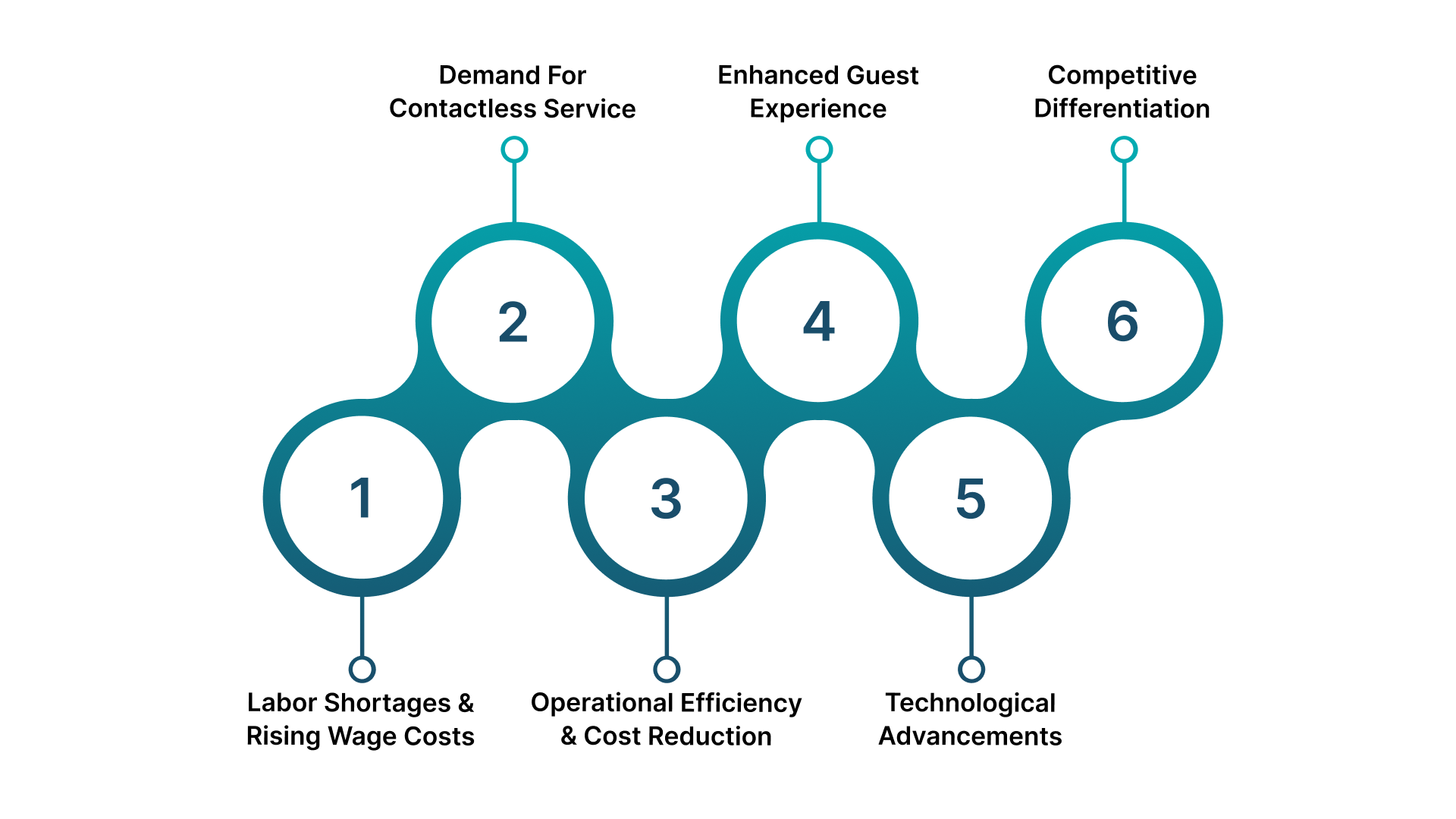
Several forces are converging to accelerate robot adoption across hospitality businesses. From workforce challenges to guest expectations, these factors are reshaping how the sector approaches service delivery and operational efficiency.
Labor Shortages and Rising Wage Costs
The hospitality sector faces persistent staffing challenges, with many regions reporting difficulty filling entry-level positions. Recent surveys indicate that 65% of hotels are dealing with staffing shortages, a challenge that extends across restaurants and resorts globally.
On top of this, wage pressures continue climbing as businesses compete for workers, increasing operational expenses significantly.
Robots offer a solution by handling time-intensive tasks reliably, thereby allowing businesses to operate effectively with leaner human teams while maintaining service quality.
Demand for Contactless Service
Guest preferences shifted noticeably toward minimal-contact experiences, particularly following health concerns in recent years. Many travelers now prefer interactions that reduce physical touchpoints while still receiving prompt service.
Robots naturally fulfill this need, delivering items and providing information without direct human contact, meeting modern expectations for hygiene-conscious service that feels both safe and convenient.
Operational Efficiency and Cost Reduction
Hospitality businesses operate on tight margins where small efficiency gains translate to meaningful financial improvements. Robots work continuously without breaks, vacation time, or shift changes, providing consistent output throughout operating hours.
This reliability reduces bottlenecks, speeds up routine processes, and lowers costs associated with errors or inconsistent service, making operations smoother and more predictable.
Enhanced Guest Experience
Today's guests expect seamless, personalized service that anticipates their needs before they ask. Robots contribute by handling routine requests instantly, freeing human staff to focus on creating memorable personal interactions.
This combination allows venues to deliver both efficiency and warmth, offering quick responses to basic needs while ensuring staff availability for meaningful guest engagement.
Technological Advancements
Recent improvements in artificial intelligence, computer vision, and sensor technology have made robots more capable and affordable than ever.
These systems now navigate complex environments reliably, understand natural language better, and integrate smoothly with existing hotel software.
As technology continues improving while costs decrease, implementation becomes practical for properties of various sizes and budgets.
Competitive Differentiation
Properties embracing robotics gain attention as innovative, forward-thinking venues that offer unique experiences. Guests often share their encounters with robots on social media, generating organic marketing and brand awareness.
This technological edge helps properties stand out in crowded markets, attracting curious travelers and positioning the business as a leader rather than a follower.
Ready to automate your hospitality business?
Explore cutting-edge robotics solutions from ToDo Robotics, like BellaBot, KettyBot, and SwiftBot, designed to enhance service, reduce labor costs, and elevate guest experiences.
Check out ToDo Robotics' hospitality solutions today and take the first step toward automating your future!
Benefits of Hospitality Robots
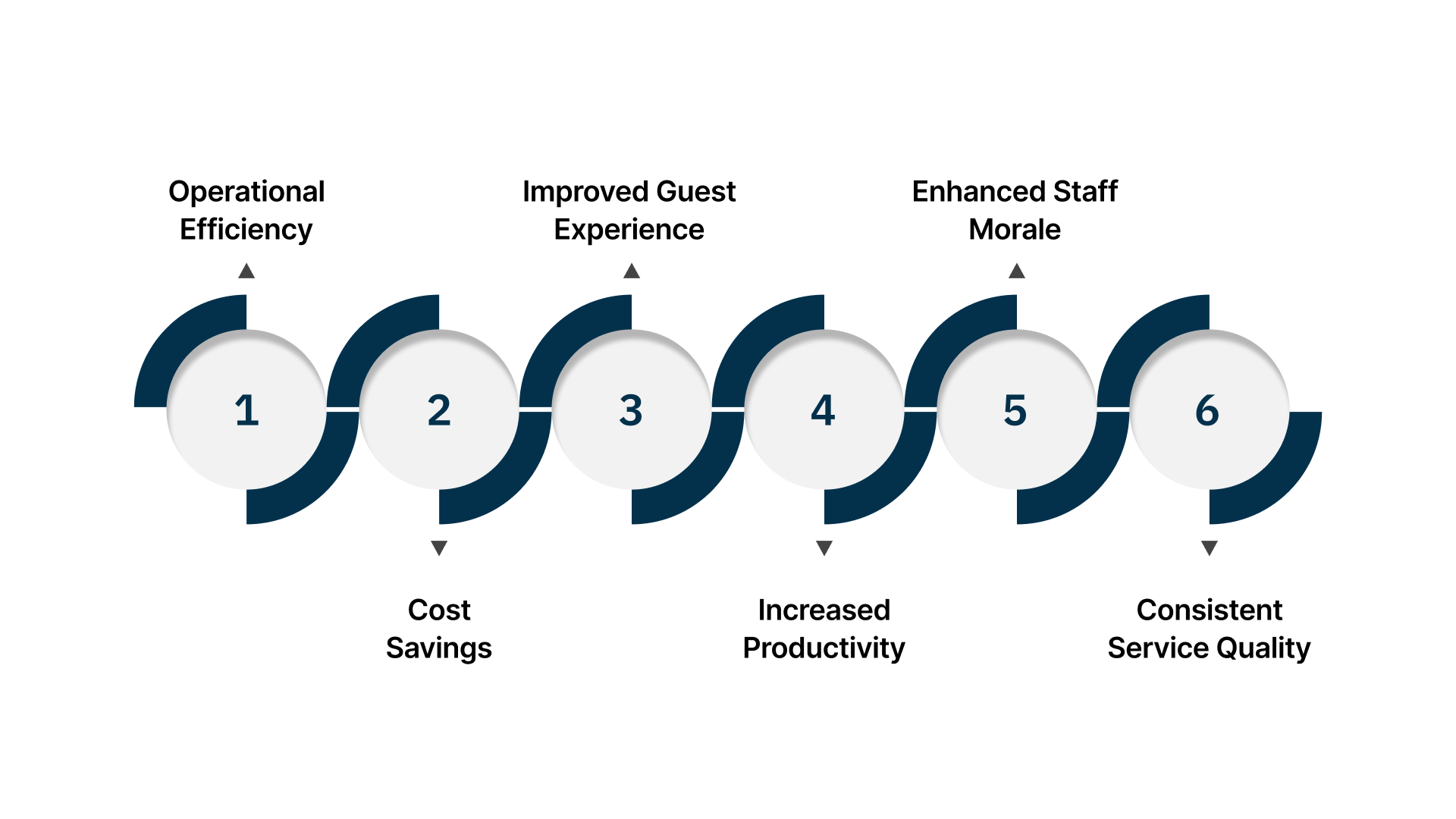
Hospitality robots deliver tangible advantages that go beyond simple automation. These benefits touch every aspect of operations, from daily workflows to guest satisfaction, creating value that compounds over time as businesses refine their use of robotic systems.
Operational Efficiency: Robots take care of repetitive tasks such as room delivery or cleaning, allowing human staff to concentrate on personalized guest interactions that require a human touch.
Cost Savings: While the initial investment can be significant, robots offer long-term savings by reducing labor costs, minimizing human errors, and improving operational consistency.
Improved Guest Experience: Robots provide quick, efficient service for routine tasks like room service delivery or check-in, which not only enhances convenience but also meets the growing demand for contactless interactions.
Increased Productivity: Robots work continuously without the need for breaks or downtime, increasing overall productivity and ensuring that operations run smoothly during peak times.
Enhanced Staff Morale: By offloading repetitive, physically demanding tasks to robots, employees can focus on more rewarding and meaningful work, which can boost job satisfaction and reduce burnout.
Consistent Service Quality: Robots provide consistent, high-quality service at all times, which helps maintain operational standards and ensure that guest expectations are met without fluctuation.
Challenges and Considerations
Adopting hospitality robots requires careful planning and realistic expectations about implementation.
While the benefits are substantial, properties face several considerations that demand thoughtful approaches to ensure successful integration and acceptance from both staff and guests.
Challenge | Solution |
|---|---|
High Initial Costs | Explore financing options or leasing models to spread out the investment. Consider starting with smaller-scale deployments and scaling up gradually. |
System Integration | Work with vendors who offer customizable robots that integrate seamlessly with existing hotel management systems. Provide training for staff to ensure smooth adoption. |
Human-Robot Interaction | Implement intuitive interfaces and provide guest education through demonstrations or clear signage. Design robots to have friendly appearances and ensure staff are trained to manage interactions. |
The Future of Hospitality Robots
Hospitality robotics continues evolving rapidly, with emerging technologies promising even greater capabilities and applications. The next generation will bring smarter interactions, deeper personalization, and genuinely intuitive integration.
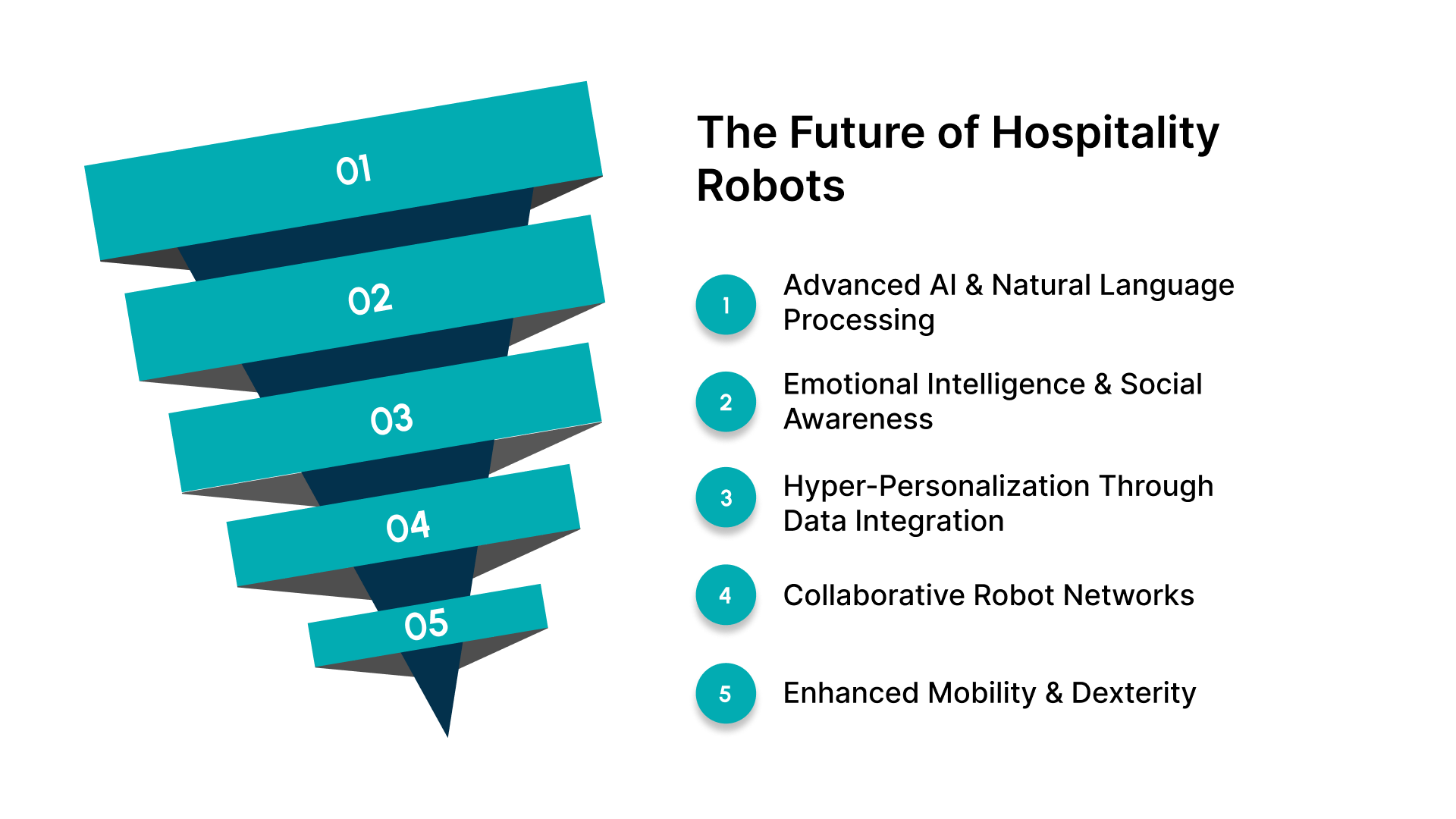
Advanced AI and Natural Language Processing
Future robots will understand complex requests through natural language processing that grasps context and nuance. Conversations will feel more natural, with robots handling multi-step requests and remembering previous interactions, transforming them into genuine service assistants.
Emotional Intelligence and Social Awareness
Next-generation robots will read facial expressions and vocal tone to gauge a guest's mood and adjust accordingly. Frustrated guests receive empathetic responses and staff escalation, while happy guests get personalized recommendations, bridging mechanical efficiency with human warmth.
Hyper-Personalization Through Data Integration
Robots will access comprehensive guest profiles to deliver truly personalized experiences. Remembering dietary preferences, room temperature likes, and past requests, they'll anticipate needs before guests voice them, creating seamless service that builds loyalty.
Collaborative Robot Networks
Multiple robots will work as coordinated teams, sharing information and dividing tasks intelligently. When one handles a delivery, others automatically adjust routes to avoid congestion, enabling complex operations like coordinated event service without human coordination.
Enhanced Mobility and Dexterity
Future robots will navigate stairs, open doors independently, and manipulate objects with human-like precision. These capabilities eliminate current accessibility limitations and enable tasks like bed making or table setting, expanding deployment flexibility throughout facilities.
Conclusion
Hospitality robots have moved beyond experimental status to become practical tools that address real operational needs. They complement human staff effectively, handling routine tasks while employees focus on creating meaningful guest connections.
The technology continues improving, costs are becoming more accessible, and properties of various sizes can now benefit from robotic assistance.
For hospitality businesses ready to enhance efficiency without sacrificing the personal touch that defines great service, robots offer a clear path forward.
Implementing robotics successfully requires the right partner with proven expertise and comprehensive support. ToDo Robotics brings together premium robots from leading manufacturers like Pudu Robotics and Gaussian Robotics with full lifecycle support that extends well beyond installation.
Our team provides everything from initial consultation and site assessment to ongoing maintenance, readily available individual parts, and 24/7 technical assistance, ensuring your robotic systems deliver consistent results.
Why Choose ToDo Robotics as Your Hospitality Automation Partner?
Choosing the right automation partner is as important as selecting the technology itself. Long-term results depend on reliability, service depth, and a clear understanding of real operational demands.
ToDo Robotics works alongside hospitality teams to deliver automation that fits daily workflows, scales with growth, and performs consistently in live environments.
Tangible ROI & Cost Reduction: Our solutions deliver significant labor cost savings and improved efficiency, often achieving breakeven within months while boosting productivity and your bottom line.
Superior Service Quality & Consistency: Elevate guest experiences with reliable delivery robots and achieve meticulous, standardized cleaning that reflects positively on your brand every time.
Empowered Workforce & Improved Environment: Automate repetitive tasks to alleviate labor shortages and free employees for engaging, customer-facing activities that improve job satisfaction and workplace safety.
Expertise You Can Trust: Our team brings 10+ years of combined deployment and technical service experience, with certified, manufacturer-trained technicians who understand automation nuances in your industry.
Comprehensive Full-Service Support: We're with you from consultation through installation, training, proactive maintenance, 24/7 technical support, readily available parts, and flexible warranty options.
Leading Technology Partnerships: We partner with industry leaders, including Pudu Robotics, Gaussian Robotics, Zaco, and Sparkoz, ensuring you receive the best, most reliable technology available globally.
Connect with us today to discover how ToDo Robotics can transform your hospitality operations with expert guidance and support that ensures your success at every stage.
FAQs:
What are hospitality robots?
Hospitality robots are automated machines designed to perform tasks like room service delivery, cleaning, and guest interaction in hotels and restaurants.
How do hospitality robots improve guest experience?
They provide efficient, contactless service, offering quick responses to basic needs, allowing human staff to focus on personalized guest interactions.
What types of tasks can hospitality robots perform?
Hospitality robots handle tasks such as room delivery, cleaning, concierge duties, and even kitchen assistance, improving operational efficiency.
What challenges do hospitality robots face?
Key challenges include high initial costs, integrating with existing systems, and overcoming potential resistance from staff and guests.
How can hospitality robots reduce costs for businesses?
Robots reduce labor costs by handling repetitive tasks, improve service consistency, and minimize errors, offering a long-term return on investment.