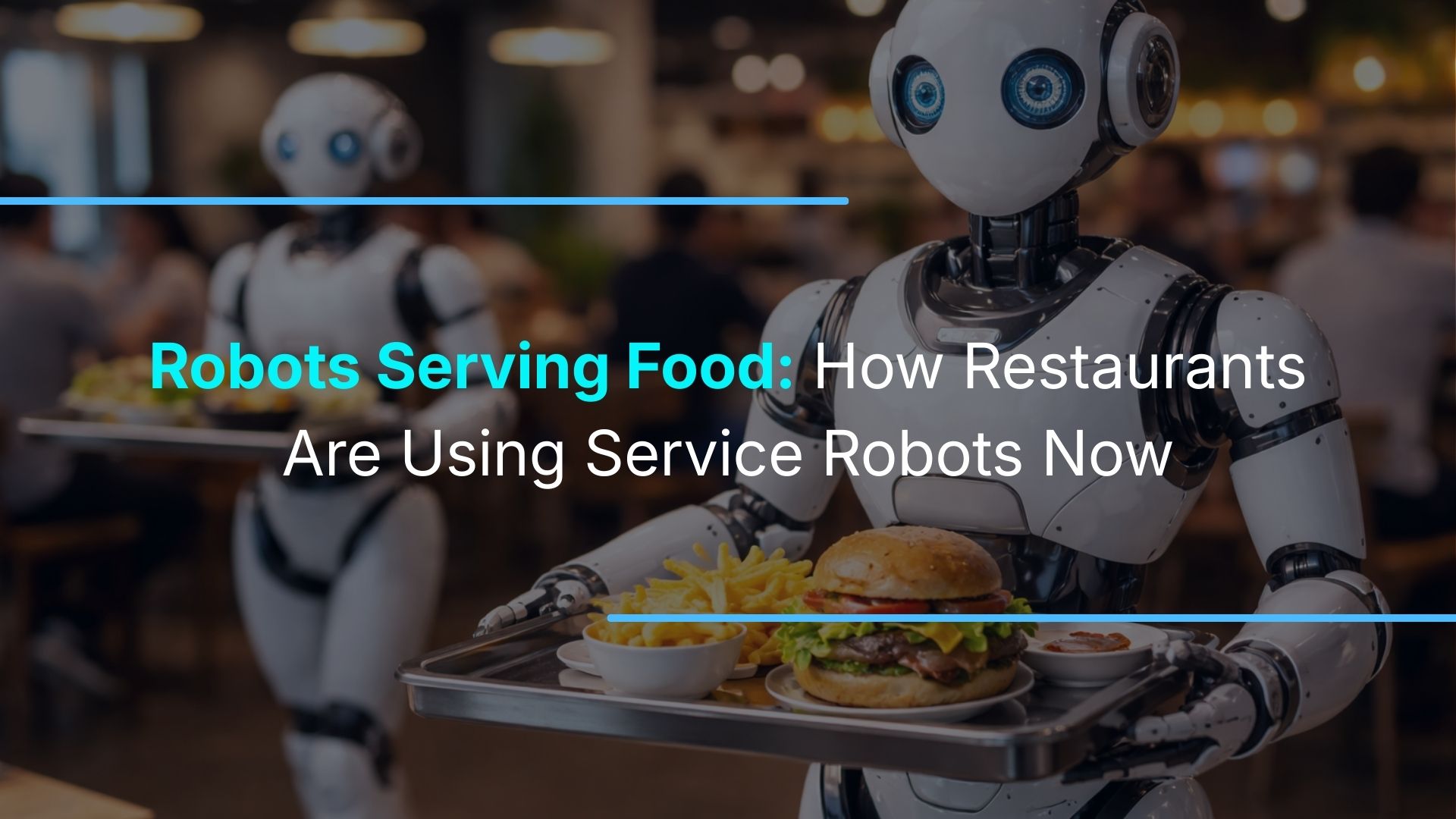
Robots serving food are no longer experimental concepts or novelty attractions. Today, they are actively used across restaurants, hotels, hospitals, and large dining halls to support daily service operations.
As labor shortages continue and customer expectations for speed and consistency rise, food-service businesses are increasingly turning to service robots to handle repetitive delivery tasks. These robots operate indoors, transporting meals from kitchens to tables, rooms, or service stations while staff focus on guest interaction and order accuracy.
This blog explains how robots serving food actually work, where they are being deployed, what tasks they perform, and the operational benefits and limitations restaurants should understand before adopting automation.
Key Takeaways
Robots serving food are now operational tools, not experimental concepts, used across restaurants, hotels, hospitals, and dining halls.
They support repetitive delivery tasks, such as food running and tray transport, without replacing servers or hospitality staff.
Labor shortages and rising wage pressure are major drivers behind restaurant automation adoption.
When integrated correctly, food-serving robots improve speed, consistency, and staff satisfaction during peak service hours.
Successful automation depends on workflow alignment, layout assessment, and ongoing support, not hardware alone.
Robots Serving Food: Everything You Need to Know
Robots serving food are indoor autonomous service robots designed to assist with meal delivery inside commercial dining environments. They are used to transport prepared food from kitchens to tables, guest rooms, or service stations without manual carrying by staff.
These robots operate entirely within indoor spaces such as restaurants, hotels, hospitals, and dining halls. Using onboard sensors and mapping technology, they navigate safely through dining areas while interacting alongside guests and employees.
Key characteristics include:
Indoor-only operation within controlled restaurant or hospitality environments
Food transport functionality, carrying trays, plates, or covered compartments
Autonomous navigation using LiDAR, cameras, and obstacle detection
Safe movement in guest-facing areas at controlled speeds
It is important to distinguish these systems from sidewalk delivery robots. Food-serving robots do not operate on public streets or sidewalks, do not perform last-mile delivery, and are not subject to municipal outdoor delivery regulations.
Instead, they focus on short-distance, high-frequency delivery inside buildings, supporting service speed, consistency, and staff efficiency during daily operations.
Where Robots Are Serving Food Today
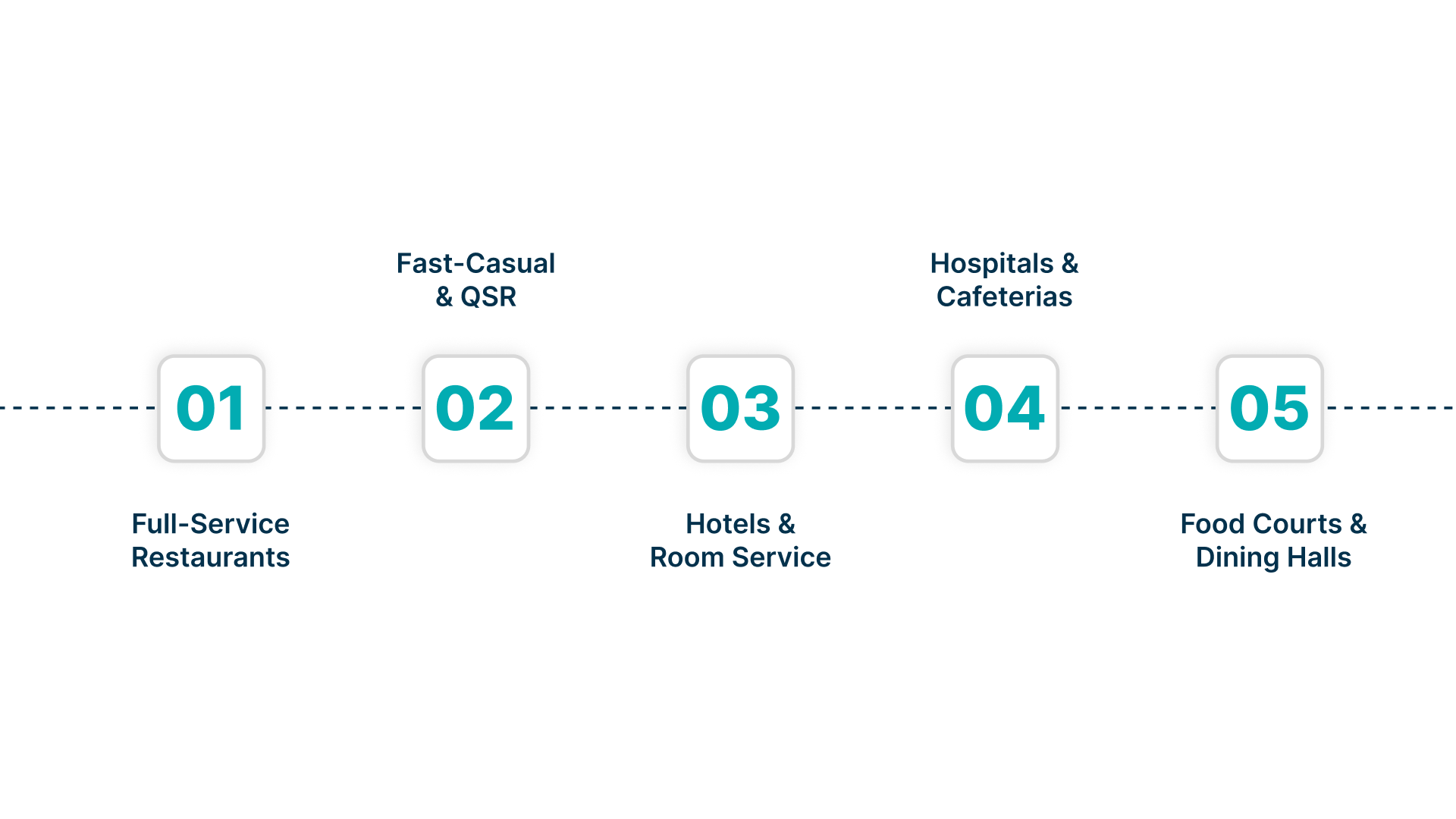
Food-serving robots are now deployed across a wide range of commercial dining environments. Their adoption is driven by high foot traffic, long service distances, and the need for consistent delivery during peak periods.
Below are the most common settings where robots are actively serving food today:
Full-Service Restaurants
In full-service restaurants, robots are primarily used as food runners. They transport multiple dishes from the kitchen to dining tables, helping reduce server walking time during busy service hours.
Common use cases include:
Supporting understaffed shifts
Delivering multiple tables at once
Maintaining service speed during peak periods
Fast-Casual And QSR
Fast-casual and quick-service restaurants use robots to improve order throughput and reduce congestion near pickup areas.
Typical applications include:
Delivering completed orders to customer pickup points
Supporting high-volume dine-in traffic
Assisting staff during rush hours
These environments benefit from predictable routes and frequent delivery cycles.
Hotels And Room Service
Hotels deploy food-serving robots for guest-facing delivery, particularly for room service and amenity transport.
Robots are commonly used to:
Deliver meals to guest rooms
Transport late-night orders
Reduce staffing pressure during overnight shifts
Their ability to operate across floors and long corridors makes them well suited for hospitality settings.
Hospitals And Cafeterias
Hospitals and healthcare facilities use food-serving robots to support patient meal delivery and cafeteria operations.
Typical use cases include:
Transporting meals to patient rooms
Delivering trays across large campuses
Supporting staff in high-demand environments
Robots help maintain consistency while reducing staff fatigue.
Food Courts And Dining Halls
Large food courts and institutional dining halls use robots to manage long walking distances and high-volume service.
Common deployments include:
Multi-vendor food delivery within shared dining spaces
Support for campus dining and corporate cafeterias
Improving turnaround times during peak meal periods
These environments benefit from the robots’ ability to handle frequent, repetitive delivery tasks efficiently.
Across these settings, robots serving food are being used not as replacements for staff, but as operational support systems, improving service flow, reducing delays, and enabling teams to focus on guest experience.
This is where ToDo Robotics works with restaurants, hospitality groups, and food-service operators to evaluate dining layouts, service workflows, and automation readiness. It helps teams identify where food-serving robots can deliver the greatest operational impact.
Real-World Use Cases of Robots Serving Food
Robots serving food are no longer limited to pilots or demonstrations. Across the United States, restaurants and hospitality operators are using service robots in live dining environments to support food delivery, beverage transport, and room service workflows.
Here are documented examples where restaurants and hospitality venues have used robots to support food and drink delivery in real service settings:
IHOP (Clovis, California)
At an IHOP in Clovis, California, a service robot has been used on the dining room floor to assist servers by delivering plates to assigned tables when staffing is limited.
The restaurant deployed the robot to help manage high volumes and reduce physical workload for staff while maintaining service standards. Operators noted the robot improved speed and supported the team during busy shifts.
Plaza Azteca (Richmond, Virginia)
Two Plaza Azteca restaurant locations in Richmond introduced robot servers that autonomously deliver food to patrons’ tables after staff load orders and input table numbers.
These deployments help reduce server walking time and maintain consistent delivery during peak dining periods, while allowing servers to spend more time engaging with guests.
Haidilao Hot Pot (Various Locations Worldwide)
At Haidilao Hot Pot restaurants, including locations that serve diners in the U.S. and globally, service robots are used to deliver dishes and bus tables in large, busy dining rooms.
This allows staff to focus on hospitality and guest interaction while robots handle repetitive food transport within indoor service areas.
Across these real-world examples, a consistent pattern emerges: restaurants that see the strongest results use food-serving robots to solve specific operational challenges rather than attempting full automation.
How Food-Serving Robots Work: Step-By-Step
Food-serving robots follow a simple, repeatable workflow designed to integrate smoothly into daily restaurant operations. Once deployed, they function as automated food runners, handling delivery tasks while staff focus on guests and order quality.
Below is a typical step-by-step breakdown of how food-serving robots operate:
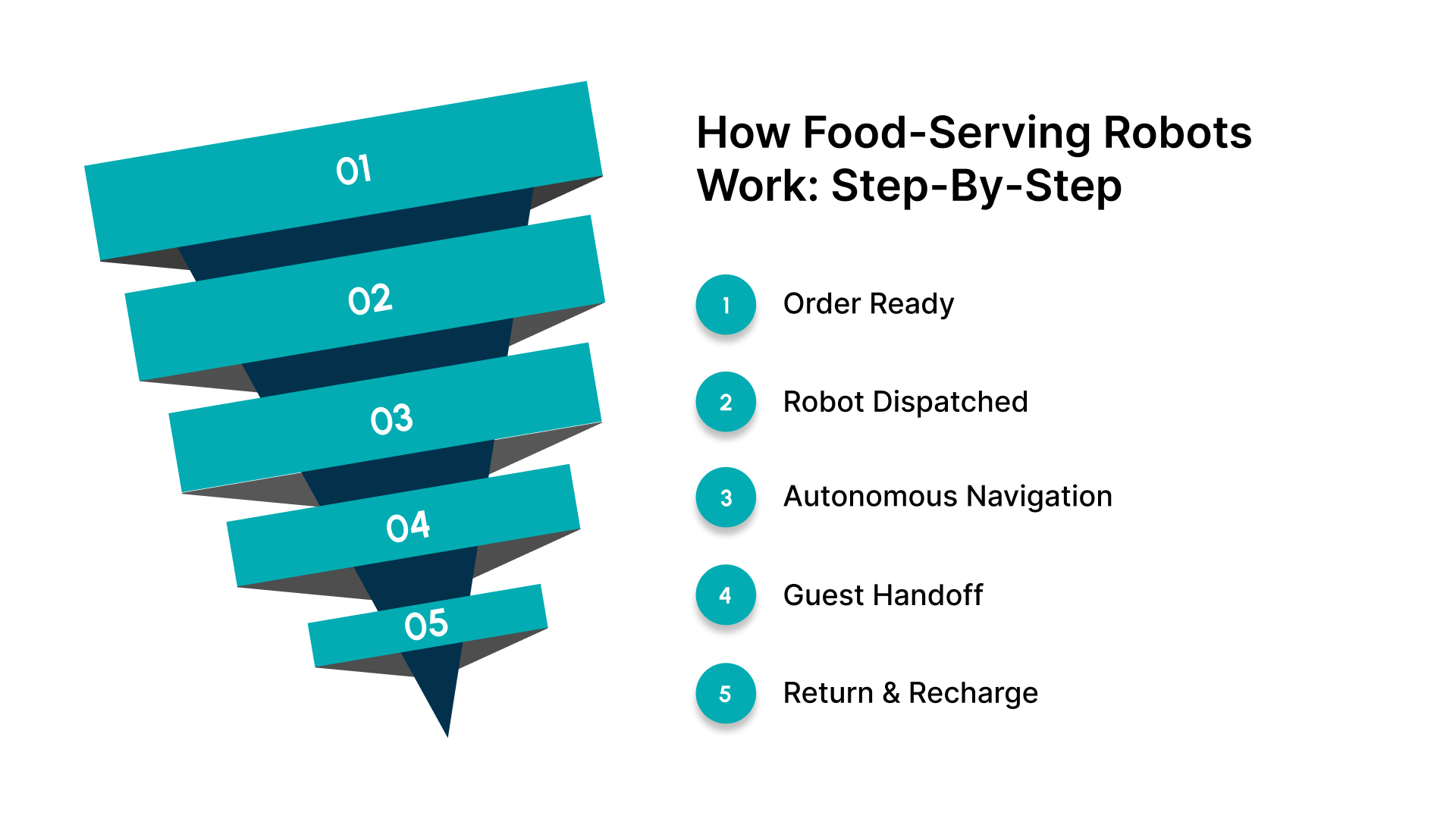
Step 1: Order Ready
Once food is prepared in the kitchen, staff place dishes or trays onto the robot’s shelves or enclosed compartments. Orders can be assigned manually or triggered through an integrated dispatch system.
This step ensures food is ready for immediate delivery without waiting for staff availability.
Step 2: Robot Dispatched
The robot is dispatched using a tablet interface, touchscreen command, or integrated workflow system. Staff select the destination table, room number, or service zone.
The robot automatically confirms the route and begins the delivery task.
Step 3: Autonomous Navigation
Using LiDAR sensors, cameras, and mapping software, the robot navigates through dining areas in real time.
Key capabilities include:
Obstacle detection and avoidance
Safe movement around guests and staff
Automatic rerouting in busy environments
The robot operates at controlled speeds suitable for guest-facing spaces.
Step 4: Guest Handoff
Upon arrival, the robot stops at the assigned location and alerts guests or staff through voice prompts or on-screen instructions.
Guests or servers retrieve the food directly from the robot, completing the delivery without physical handoff.
Step 5: Return And Recharge
After delivery, the robot automatically:
Returns to the kitchen or standby zone
Accepts the next delivery task
Navigates to its charging station when battery levels are low
Automated charging enables continuous operation across service hours with minimal downtime.
By following this structured process, food-serving robots provide consistent delivery speed, reduce staff walking distances, and support reliable service flow during both peak and off-peak hours.
Why Restaurants Are Using Food-Serving Robots in 2026
Restaurants are adopting food-serving robots not as a novelty, but as a response to ongoing operational pressure. Over the past few years, service teams have faced increasing challenges that directly impact speed, consistency, and profitability.
The most common drivers include:
Labor shortages: Many restaurants struggle to maintain full staffing levels, especially during evenings and weekends. Robots help maintain service flow even when teams are short-handed.
Rising wages: Higher hourly wages increase the cost of repetitive, low-value tasks such as food running. Automating these movements helps control labor spend without reducing service quality.
High employee turnover: Constant hiring and training disrupt service consistency. Robots provide predictable support regardless of staff changes.
Long walking distances: Large dining rooms, food courts, and multi-zone layouts require servers to spend significant time walking rather than engaging guests. Robots reduce unnecessary movement.
Peak-hour delays: During lunch and dinner rushes, food often waits for runners. Robots ensure completed orders leave the kitchen immediately, improving table turnover and guest satisfaction.
By addressing these pain points, food-serving robots help restaurants stabilize operations, protect service quality, and support staff during the most demanding periods of the day.
What Tasks Food-Serving Robots Actually Perform
Food-serving robots are designed to support restaurant teams by handling repetitive, movement-based tasks. They are not intended to replace front-of-house staff or manage customer interactions independently.
Understanding what these robots do and do not do is essential for successful deployment.
Food-serving robots are commonly used for:
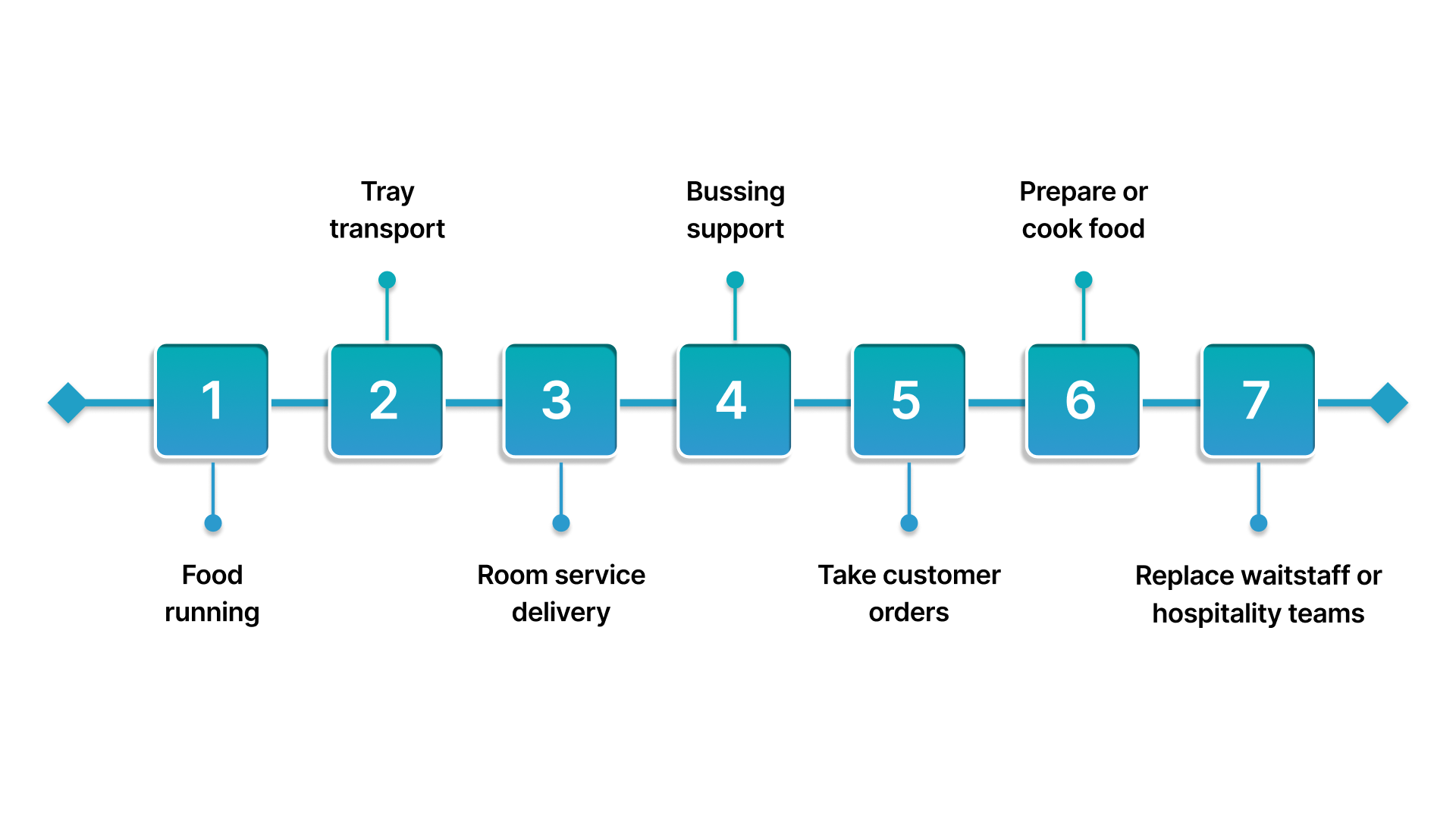
Food running: Transporting prepared dishes from the kitchen to tables or service stations.
Tray transport: Carrying multiple plates or trays in a single trip to reduce back-and-forth movement.
Room service delivery: Delivering meals and amenities in hotels and hospitality environments.
Bussing support: Transporting used dishes back to dishwashing or service areas during peak periods.
These tasks allow staff to spend less time walking and more time focused on guest service.
Food-serving robots are not designed to replace core restaurant roles. They do not:
Take customer orders or interact conversationally like servers
Prepare or cook food in the kitchen
Replace waitstaff or hospitality teams
Instead, robots function as operational support tools, assisting with delivery while people handle service, hospitality, and decision-making.
When used appropriately, food-serving robots enhance speed and consistency without changing the human-centered nature of restaurant service. Clear role definition helps ensure automation improves workflows rather than complicating them.
Business Benefits Of Robots Serving Food in 2026
Robots serving food deliver measurable operational value by addressing the everyday challenges that affect speed, staffing efficiency, and service consistency.
When integrated into existing workflows, they function as reliable support systems that improve performance without disrupting hospitality standards.
Key business benefits include:
Faster table turns: Immediate food delivery from kitchen to table reduces wait time, helping restaurants serve more guests during peak hours.
Consistent delivery speed: Robots maintain the same pace throughout service, ensuring completed orders are delivered promptly regardless of staff availability.
Reduced employee burnout: By eliminating long walking routes and repetitive running tasks, robots help reduce physical fatigue and improve staff retention.
Better guest experience: Faster service, fewer delays, and predictable food arrival contribute to higher satisfaction and stronger reviews.
Predictable service flow: Robots follow structured delivery routes, creating dependable movement patterns during both rush and non-peak periods.
By assigning repetitive delivery tasks to food-serving robots, restaurants can offset a significant portion of this cost while improving delivery speed and service consistency.
Actual ROI depends on:
Dining area size and walking distance
Daily order volume
Peak-hour traffic patterns
Number of service hours
By improving throughput and reducing labor strain, robots serving food help restaurants maintain performance standards even as staffing challenges continue.
Safety And Guest Experience Considerations
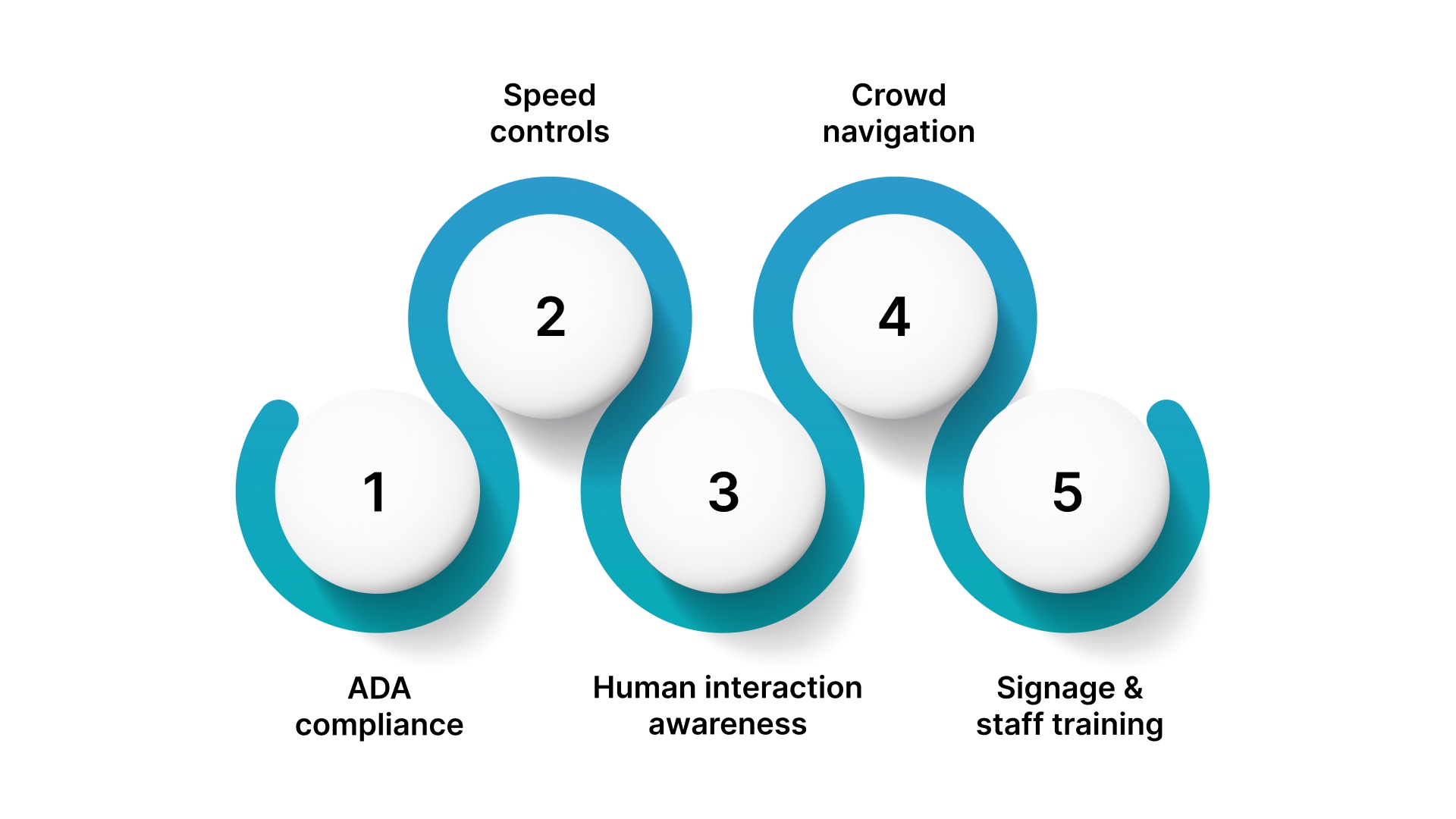
Safety and guest comfort are critical when deploying food-serving robots in active dining environments. Modern service robots are designed specifically for indoor, guest-facing use and operate within clearly defined safety parameters.
Key considerations include:
ADA compliance: Robots are configured to maintain appropriate aisle clearance and navigate without obstructing accessible pathways.
Speed controls: Adjustable speed settings ensure slower movement in dining areas and higher efficiency in back-of-house zones.
Human interaction awareness: Sensors allow robots to detect people, pause when approached, and resume movement only when paths are clear.
Crowd navigation: Advanced obstacle detection enables safe operation during busy service periods without abrupt stops or collisions.
Signage and staff training: Clear signage and proper team training help guests understand robot behavior and ensure smooth daily operation.
When deployed correctly, food-serving robots enhance service flow without disrupting the dining atmosphere or guest comfort.
Are Robots Replacing Restaurant Staff in 2026?
Food-serving robots are not designed to replace restaurant employees. Instead, they serve as operational support tools that assist with repetitive, physically demanding tasks.
Their role focuses on:
Supporting staff, not substituting them: Robots handle food running and transport while people manage hospitality, communication, and service decisions.
Improving employee retention: Reducing long walking distances and physical strain helps limit burnout and turnover.
Freeing staff for guest interaction: With delivery tasks automated, servers spend more time engaging customers, upselling, and maintaining service quality.
Rather than reducing headcount, robots help restaurants operate more effectively with existing teams, especially during peak hours and staffing shortages.
By combining human hospitality with automated delivery support, restaurants can maintain service standards while creating a more sustainable working environment.
How ToDo Robotics Helps Implement Food-Serving Robots
As food service operations across the United States continue to adapt to labor shortages and rising service demands, food-serving robots have become a practical way to improve delivery speed and operational consistency.
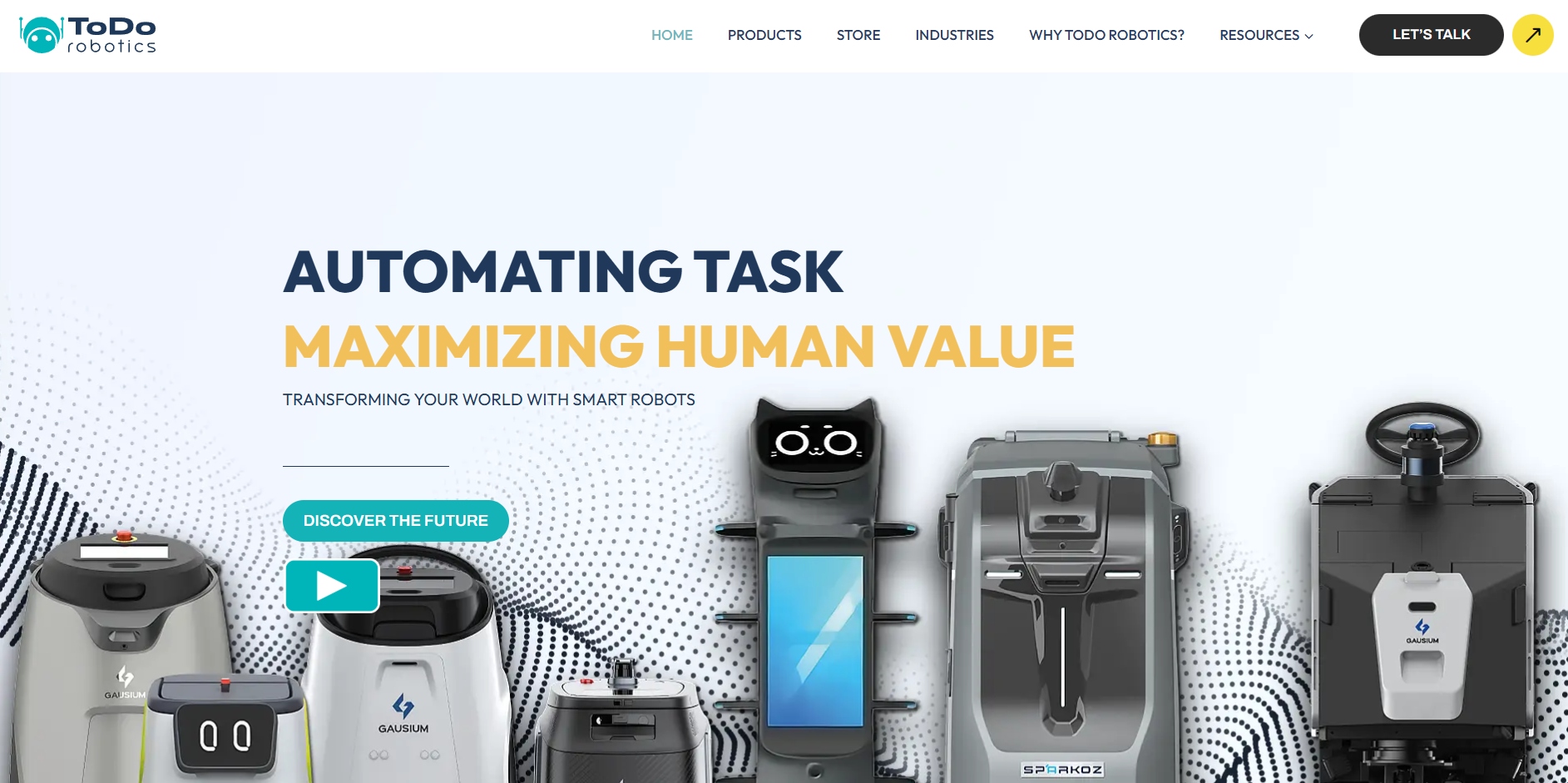
ToDo Robotics supports restaurants, hospitality groups, and commercial dining facilities by providing deployment-ready service robot solutions designed for real-world service environments.
Rather than offering standardized technology packages, ToDo Robotics follows an application-specific approach based on dining layout, service flow, operating hours, and guest traffic patterns.
Depending on operational requirements, ToDo Robotics provides:
Indoor food-serving robots designed to transport meals from kitchens to tables, rooms, or service stations.
Multi-tray and enclosed delivery robots optimized for table service, room service, food courts, and large dining areas.
Autonomous navigation systems using LiDAR and vision-based mapping for safe operation in guest-facing environments.
Fleet management software enabling real-time dispatch, delivery tracking, and coordination across multiple robots.
Robot configurations are selected based on how food service operations actually function, not on hardware specifications alone. ToDo Robotics works with operators to align robot deployment with walking distances, order volume, peak-hour pressure, and staffing models.
To support reliable daily operation, deployments may include:
Workflow integration aligned with existing service processes
Configurable speed zones for dining areas and back-of-house spaces
Automated charging for continuous service-hour operation
This ensures food-serving robots function as a seamless extension of restaurant operations rather than a standalone technology layer.
Beyond food-serving robots, ToDo Robotics offers a broader portfolio of commercial automation solutions designed to support efficiency, cleanliness, and operational consistency across hospitality and food-service environments.
These offerings include:
Autonomous cleaning robots for dining rooms, kitchens, corridors, and high-traffic public areas.
Robotics consultation and site assessments to evaluate layout feasibility, workflow impact, and automation ROI.
Installation and commissioning services, including mapping, testing, and on-site configuration.
Staff training programs, delivered in person or remotely to ensure confident and safe operation.
Ongoing maintenance and technical support, including preventive servicing, software updates, and parts availability.
By delivering service robots, cleaning automation, deployment expertise, and long-term support under a single framework, ToDo Robotics helps food-service businesses adopt automation strategically.
Conclusion
Robots serving food present different operational considerations depending on dining layout, service volume, staffing levels, and daily workflow demands. Deploying the wrong solution or implementing automation without proper planning can limit efficiency gains and affect guest experience.
ToDo Robotics supports food-service businesses through application-specific service robots, workflow-aligned deployment planning, and full-lifecycle support designed for real restaurant and hospitality environments.
Speak with ToDo Robotics to discuss how food-serving robots can support your service operations and long-term automation strategy.
Frequently Asked Questions (FAQs)
1. How much do food-serving robots typically cost?
Costs vary based on robot type, configuration, and support model. Pricing is usually structured as a subscription or purchase with ongoing service options.
2. Do food-serving robots work during peak dining hours?
Yes. These robots are designed to operate in busy environments and are commonly used during lunch and dinner rush periods.
3. Can food-serving robots operate in small restaurants?
They are best suited for locations with longer walking distances, but compact layouts may still benefit depending on service flow.
4. Do guests respond positively to robots serving food?
Most guests view food-serving robots as helpful and engaging, especially when they improve delivery speed without reducing human interaction.
5. How long does it take to deploy food-serving robots?
Deployment timelines vary, but most installations are completed within days to a few weeks after site assessment and configuration.