Airports operate under constant pressure to deliver fast, consistent service across large terminal spaces while managing staffing shortages and fluctuating passenger volumes. Long walking distances, peak-hour congestion, and extended operating hours make it difficult for food service teams and lounge staff to maintain service speed using manual workflows alone.
Serving robots are increasingly being used as operational support tools within airport terminals. These indoor service robots assist with food and beverage delivery, tray transport, and routine service movement across concourses and food courts, helping staff maintain consistent service flow during busy periods.
This guide explains how serving robots are used in airport environments today, where they fit operationally, the types of tasks they support, and what airport operators should consider before deployment.
Key Takeaways
Airports are adopting serving robots to support food and beverage operations amid staffing shortages and long terminal walking distances.
Serving robots are used in real airport zones including food courts, lounges, concourses, and back-of-house service routes.
Airport environments require robots designed for public safety, security-controlled access, and continuous passenger movement.
Different robot types like tray-based, enclosed, multi-tray, and hybrid models serve distinct operational roles within terminals.
ToDo Robotics supports airport deployments through site assessment, route mapping, workflow integration, and ongoing operational support.
What is the Relevance of a Serving Robot in Airports?
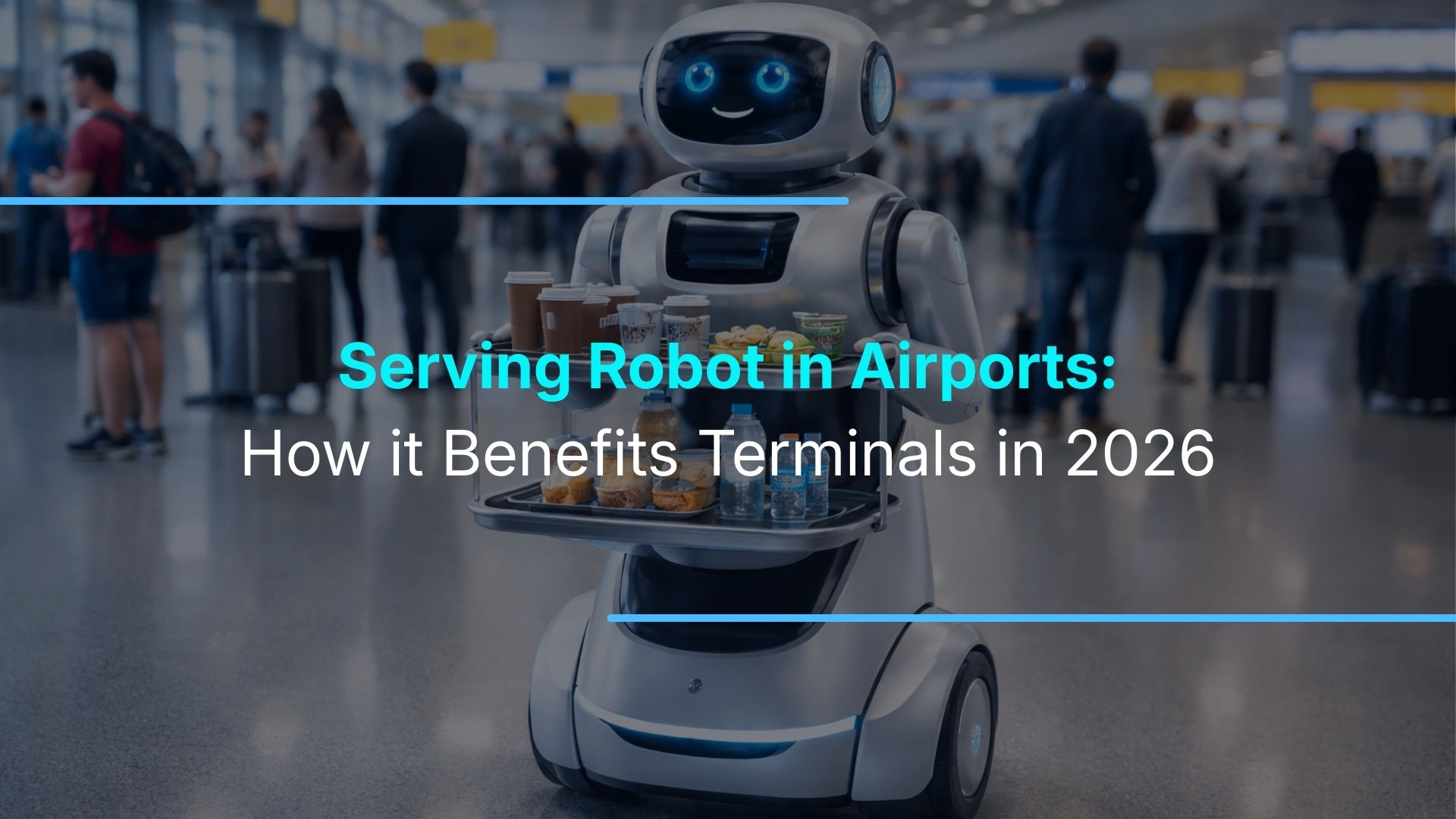
A serving robot for airports is an indoor autonomous service robot used to transport food, beverages, trays, or service items across terminal spaces. These robots operate within public areas such as food courts, lounges, and concourses, supporting service teams by handling repetitive delivery movement rather than replacing staff interactions.
Unlike traditional restaurant environments, airports function as large, continuously active facilities. Service robots deployed in terminals must be capable of operating safely over long distances while navigating unpredictable passenger movement and shared infrastructure.
Key differences between airport serving robots and restaurant-only robots include:
Longer travel distances: Airport layouts often require robots to move hundreds of meters between kitchens, counters, lounges, and seating zones, far beyond typical restaurant floor plans.
Public safety requirements: Robots must operate safely around travellers, luggage carts, wheelchairs, and children, using controlled speeds, obstacle detection, and visible safety indicators.
Multi-tenant layouts: Terminals house multiple food brands and service operators within shared spaces, requiring robots to function across open food courts rather than closed dining rooms.
Security-controlled environments: Robots must comply with restricted-access zones, approved operating paths, and airport security protocols that do not apply to standard hospitality venues.
Because of these operational conditions, serving robots in airports are deployed as support infrastructure.
Their role is to reduce walking time, maintain service flow during peak travel hours, and help concession teams operate more efficiently across expansive terminal environments.
Where Serving Robots Are Used in Airports
Serving robots are deployed in specific airport zones where repetitive movement, long distances, and peak-hour congestion place consistent strain on service staff. Their use is typically focused on supporting routine transport tasks rather than replacing customer-facing roles.
Below are the most common operational scenarios where serving robots are currently used in airport environments:
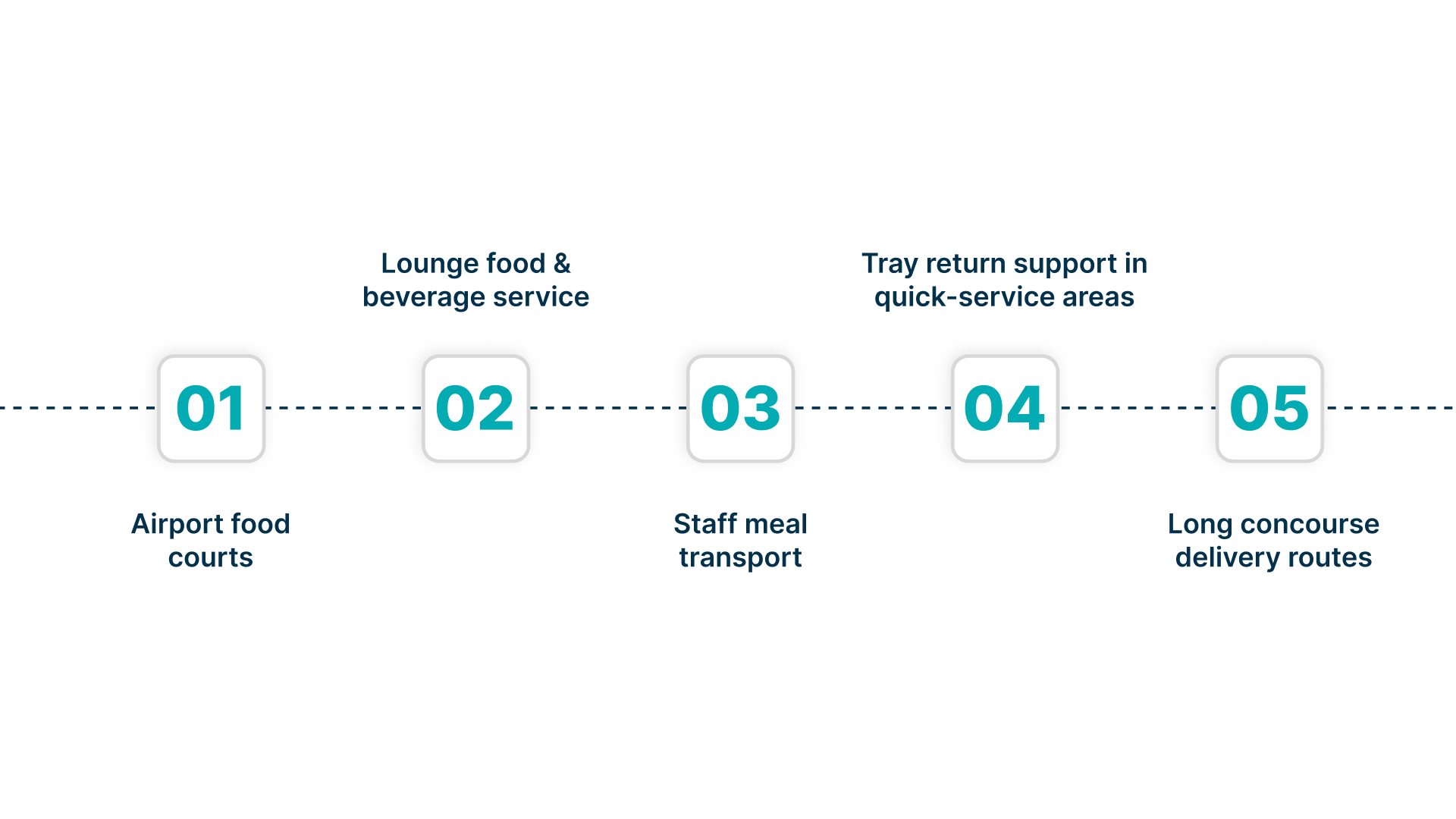
1. Airport food courts: In large terminal food courts, serving robots are used to support order-to-table delivery from central kitchens or service counters. These spaces often experience heavy foot traffic and long walking distances, especially during peak departure windows.
Robots help move prepared food and beverages across shared seating areas, allowing staff to remain at counters while maintaining consistent delivery flow.
2. Lounge food and beverage service: Airport lounges frequently operate with limited staff while covering large seating zones. Serving robots are used to transport food trays, beverages, and replenishment items between prep areas and lounge sections.
This support reduces repeated walking for attendants and helps maintain service consistency during busy travel periods.
3. Staff meal transport: In some terminals, kitchens are located away from service counters due to space constraints. Serving robots are used to transport staff meals or prepared items between back-of-house kitchens and concession areas.
This application helps streamline internal movement without interfering with passenger-facing operations.
4. Tray return support in quick-service areas: High-volume quick-service restaurants generate continuous tray return movement.
Serving robots can assist by transporting used trays from dining zones to collection areas, reducing congestion and improving floor cleanliness during rush periods. This is particularly useful in terminals with limited back-of-house access.
5. Long concourse delivery routes: Some airports use serving robots to support deliveries across extended concourses, including movement between terminal sections or satellite gates.
These routes are typically predefined and mapped to avoid restricted zones and passenger bottlenecks. Robots operating in these areas help reduce staff fatigue caused by long-distance walking across terminals.
Across all scenarios, serving robots function as mobility support tools, handling repetitive transport tasks so airport staff can focus on service quality, passenger assistance, and operational oversight.
Real-World Examples of Serving Robots in Airport Terminals
Several airports around the world are already using autonomous service robots to support food and beverage delivery within active terminals. These deployments focus on practical operational needs such as reducing walking distances, maintaining service speed during peak travel periods, and supporting limited staffing across large concourses.
The following examples highlight how serving robots are currently being used in live airport environments to transport food and beverages safely among passengers, staff, and airport infrastructure:
1. Ottonomy’s “Ottobots” at Cincinnati/Northern Kentucky International Airport
A fleet of autonomous delivery robots launched in Concourse B that allows passengers to order food, beverages, and retail items via their mobile devices and receive them at their location through robot delivery. These robots operate fully autonomously inside the terminal.
2. Gita food delivery robots at Philadelphia International Airport (PHL)
The “Gita” robot is deployed to carry food orders from restaurants directly to passengers waiting in lounges, providing contactless delivery service in public airport spaces.
3. Meituan delivery robots at Shenzhen Bao’an International Airport
Autonomous delivery robots operate in the airport’s Satellite Concourse to bring meals from participating merchants (such as Starbucks and KFC) directly to passengers waiting at their gates.
These examples show real operational use of serving and delivery robots in active airport environments, supporting food and beverage service rather than being purely experimental or conceptual.
Why Airports Are Adopting Serving Robots in 2026
Airports operate as high-traffic environments with long operating hours and constant fluctuations in passenger volume. Maintaining consistent service levels across terminals has become increasingly difficult using manual staffing alone.
Serving robots are being adopted to address specific operational pressures rather than to introduce novelty.
Key drivers include:
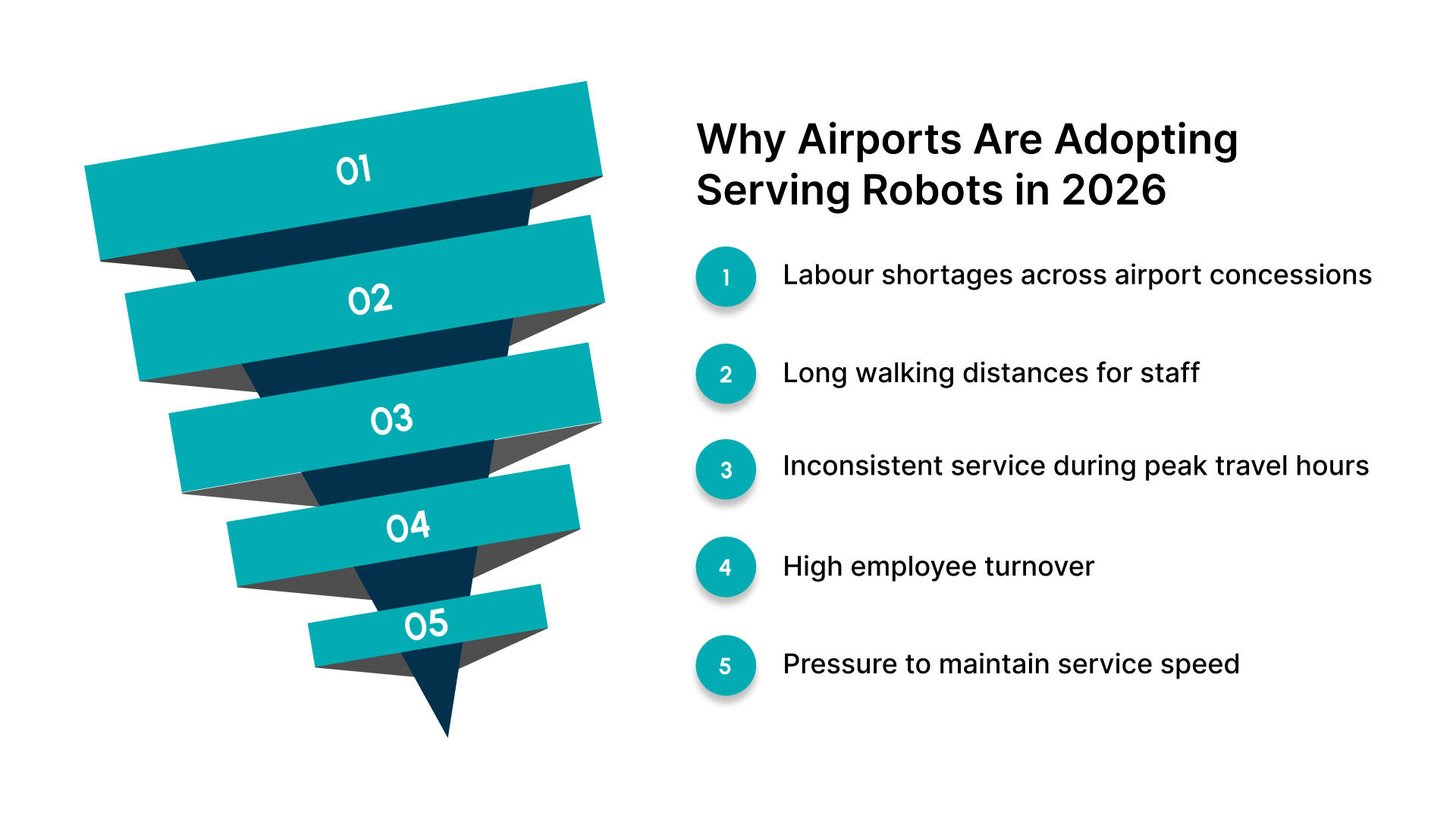
Labour shortages across airport concessions: Food courts and lounges often struggle to maintain adequate staffing, particularly during early-morning and late-night shifts. Serving robots help cover routine transport tasks when staffing levels are limited.
Long walking distances for staff: Terminal layouts require employees to travel significant distances between kitchens, counters, lounges, and seating areas. Robots reduce repeated walking, allowing staff to stay focused on preparation and customer interaction.
Inconsistent service during peak travel hours: Passenger surges during boarding windows and delays place sudden pressure on food and beverage operations. Robots help stabilize delivery flow when demand increases.
High employee turnover: Repetitive walking and physically demanding shifts contribute to turnover in airport concessions. Using robots to handle movement-heavy tasks helps reduce fatigue and improve role sustainability.
Pressure to maintain service speed: Travellers expect quick service between flights, even during congestion. Serving robots support predictable delivery times across large terminals without requiring additional headcount.
Together, these factors make serving robots a practical operational tool for airports seeking to maintain service reliability in complex, high-volume environments.
What Makes Airports Different from Restaurants
While serving robots are also used in restaurants, airport environments introduce a very different set of operational challenges.
Terminal spaces are larger, more complex, and continuously active, requiring robots designed specifically for public infrastructure rather than closed dining rooms.
Key differences include:
1. Mixed pedestrian traffic: Airports involve constant movement from travellers, airline staff, families, and service crews. Robots must operate safely around unpredictable walking patterns and sudden stops.
2. Luggage movement: Rolling suitcases, trolleys, strollers, and cargo carts create dynamic obstacles that change throughout the day. Airport robots require advanced obstacle detection and stable path planning to navigate these conditions.
3. Escalators and elevators: Terminal layouts often span multiple levels. Robots must be restricted to approved floors or integrated with designated elevator access, unlike restaurant robots that operate on a single level.
4. Security-controlled zones: Airports include restricted areas where access is tightly regulated. Serving robots must follow approved routes and comply with airport security protocols that do not apply in standard hospitality venues.
5. 24/7 operating hours: Many terminals operate continuously, requiring robots capable of reliable long-duration use, scheduled charging, and consistent performance without disrupting overnight operations.
Because of these factors, serving robots used in airports must prioritise safety, navigation accuracy, and operational reliability. They function as part of airport infrastructure, not simply as restaurant service tools.
Types of Serving Robots Used in Airports
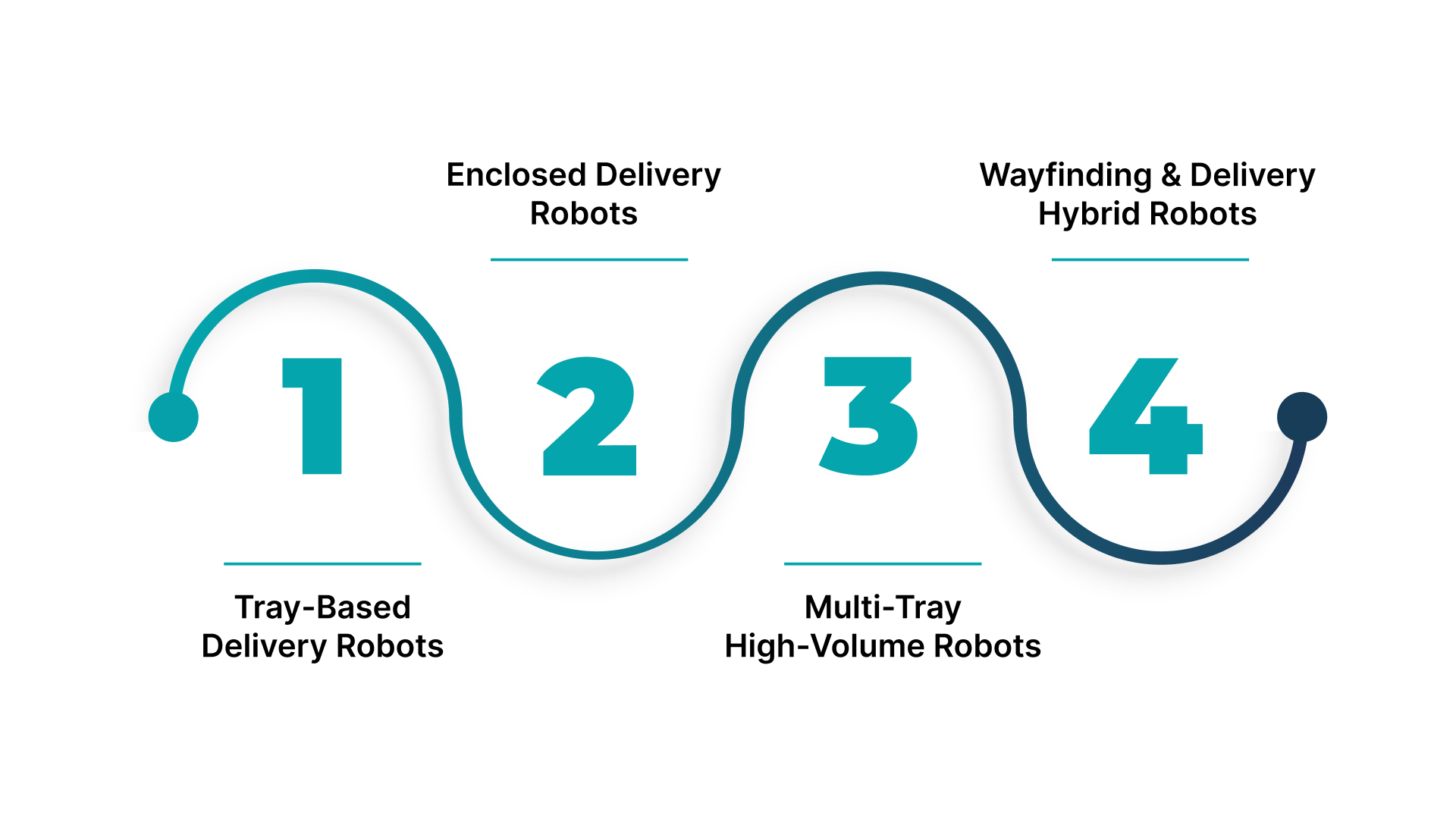
Airports use different types of serving robots depending on terminal layout, service volume, and operational priorities. Rather than relying on a single robot design, most deployments focus on matching robot capabilities to specific service tasks and movement patterns.
The main categories used in airport environments are outlined below:
Tray-Based Delivery Robots
Tray-based robots are designed to transport prepared food and beverages on open trays. They are commonly used for short-to-medium distance delivery within food courts and lounges.
These robots typically operate along predefined routes between kitchens, counters, and seating areas, supporting order-to-table service without requiring staff to walk long distances.
Common uses include:
Food court order delivery
Lounge snack and beverage service
Internal transport between prep and service zones
For example, BellaBot, a multi-tray indoor delivery robot widely used in hospitality environments, suitable for airport food courts and lounge service where frequent short-distance delivery is required.
Enclosed Delivery Robots
Enclosed delivery robots use sealed compartments to protect items during transport. This design helps maintain hygiene and prevents spillage while moving through crowded terminals.
They are often used where food or beverages must travel longer distances or pass through high-traffic areas.
Common uses include:
Delivery between terminals or concourse sections
Transport of packaged meals and beverages
Contact-limited service in lounges or premium areas
For example, Pudu FlashBot is an enclosed delivery robot designed for safe, contact-limited transport in public indoor environments.
Multi-Tray High-Volume Robots
Multi-tray robots are built to support higher delivery volume within short timeframes. These robots can transport multiple orders at once, making them suitable for peak travel periods.
They are frequently used in airport food courts where multiple outlets share common seating areas.
Common uses include:
Simultaneous delivery of multiple food orders
Support during flight delays and congestion
High-throughput concession zones
For example, Pudu BellaBot Pro supports higher payloads and multiple deliveries in a single route.
Wayfinding and Delivery Hybrid Robots
Some airport robots combine serving functions with wayfinding capabilities. In addition to transporting items, they provide visual prompts, directional guidance, or messaging to passengers.
These robots are typically deployed in controlled areas where passenger engagement and navigation assistance complement service delivery.
Common uses include:
Passenger guidance within terminals
Promotional or informational support
Combined food delivery and navigation assistance
For example, Pudu KettyBot is a delivery robot with an integrated display used for guidance, messaging, and light delivery tasks in public-facing environments.
Each category addresses a different operational need, which is why airports often deploy multiple robot types across terminals. This task-based approach allows serving robots to support service flow while maintaining safety and reliability in complex airport environments.
How ToDo Robotics Implements Serving Robots in Airports
As airports across the United States manage ongoing labor shortages, long terminal walking distances, and fluctuating passenger volumes, serving robots have become a practical way to support food and beverage operations while maintaining consistent service flow.
ToDo Robotics works with airport operators and concession partners to deploy serving robot solutions designed specifically for indoor terminal environments.
Rather than offering standardized technology packages, ToDo Robotics follows an application-specific approach based on terminal layout, concession placement, passenger traffic patterns, operating hours, and security requirements.
Depending on operational requirements, ToDo Robotics provides:
Indoor serving robots designed to transport food, beverages, trays, and packaged items across terminal spaces.
Tray-based and enclosed delivery robots suited for high-traffic concourses and food court environments.
Autonomous navigation systems using LiDAR and vision-based mapping for safe movement around passengers and luggage.
Fleet management software that supports task dispatch, delivery tracking, and coordination across multiple robots.
Robot configurations are selected based on how airport food service operates in practice, including walking distances between kitchens and counters, peak travel windows, service volume, and staffing availability.
To support reliable daily operation, deployments may include:
Integration aligned with existing food court and lounge workflows
Configurable speed zones for passenger areas, seating zones, and service corridors
Automated charging to support continuous multi-shift operations
This approach ensures serving robots function as an operational support layer within airport terminals rather than a separate or disruptive technology.
Beyond serving robots, ToDo Robotics offers a broader range of automation solutions to support consistency, cleanliness, and uptime across airport environments.
These include:
Autonomous cleaning robots for food courts, lounges, concourses, and high-traffic public areas.
Robotics consultation and site assessments to evaluate terminal layout feasibility, workflow alignment, and deployment planning.
Installation and commissioning services, including mapping, testing, and on-site configuration.
Staff training programs delivered in person or remotely to ensure safe and confident operation.
Ongoing maintenance and technical support, including preventive servicing, software updates, and parts availability.
By combining serving robots, cleaning automation, deployment expertise, and long-term support under a single operational framework, ToDo Robotics helps airports implement robotics in a structured, reliable, and passenger-safe manner.
Conclusion
Serving robots in airport environments involve different operational considerations depending on terminal size, concourse layout, passenger traffic levels, security constraints, and daily food service workflows. Deploying the wrong robot, or introducing service automation without proper planning, can limit efficiency gains and disrupt passenger movement.
ToDo Robotics supports airports and concession operators through application-specific serving robot selection, workflow-aligned deployment planning, and full-lifecycle support designed for active terminal environments.
Speak with ToDo Robotics to discuss how serving robots can support airport operations and long-term automation strategy.
Frequently Asked Questions (FAQs)
1. Do serving robots require approval from airport authorities?
Yes. Robots typically must be reviewed and approved by airport operations or facilities teams to ensure they comply with terminal safety policies, route restrictions, and public-area operating guidelines.
2. Can serving robots operate across different airline terminals?
Most serving robots are configured to operate within defined zones. Movement between terminals or secured areas depends on airport access rules, layout design, and whether approved pathways or elevators are available.
3. How do serving robots handle flight delays or surges?
Robots follow scheduled routes but can be reassigned or paused during congestion. During peak disruption periods, they are often used to support internal transport tasks rather than passenger-facing delivery.
4. Are airport serving robots integrated with point-of-sale systems?
In many deployments, robots operate independently of POS systems. Orders are prepared by staff, and robots are dispatched for delivery once items are ready, allowing integration without modifying existing systems.
5. What happens if a robot encounters an unexpected obstruction?
Serving robots are designed to stop safely, reroute, or wait until a clear path is available. If needed, staff can manually reposition the robot or temporarily pause its task through the control interface.