High-traffic commercial facilities now treat floor care as an operational systems challenge rather than a janitorial function. Restaurants, hospitals, retail complexes, and airports face continuous cleanliness expectations driven by safety audits and customer perception. Manual workflows often fail under peak-hour demand and spatial scale.
Repetitive floor cleaning tasks inflate labor costs and increase turnover risk. Human fatigue introduces variability in coverage, dwell time, and chemical application. These gaps directly impact compliance outcomes and service experience. Automated commercial robotics services address these structural inefficiencies through programmable, sensor-driven floor scrubbing.
Compared to manual cleaning, contact-free cleaning is expected to grow significantly, prompting industrial and commercial floor scrubber manufacturers to expand autonomous production capabilities. The discussion around manual vs robotic floor scrubbers for businesses now focuses on throughput, labor optimization, and operational resilience. Robotic systems deliver repeatable cleaning cycles, real-time telemetry, and standardized coverage across large footprints.
This article explores cleaning methodologies, machine classifications, automation benefits, and why modern enterprises prioritize robotic scrubbers over manual cleaning.
Key Takeaways
Robotic scrubbers improve cleaning speed and consistency, covering 3–20 times more area than manual methods.
Intelligent routing reduces blind spots, even in complex or unstructured environments.
Automation lowers labor dependency and operational costs while freeing staff for customer-focused tasks.
Industry-specific designs enhance hygiene compliance in hospitals, food processing, and eldercare facilities.
Long-term ROI, reduced consumable usage, and centralized monitoring make robotic scrubbers a strategic investment.
Manual vs Robotic Floor Scrubbers for Businesses: 5 Key Differences at a Glance
When it comes to keeping commercial floors spotless, the choice between manual and robotic scrubbers can dramatically impact efficiency, consistency, and labor costs. Here’s a quick comparison to help you see the key differences at a glance.
Feature | Manual Floor Scrubbers | Robotic Floor Scrubbers |
Labor Requirement | High; requires constant operator presence | Minimal; runs autonomously with occasional supervision |
Consistency | Cleaning quality varies with operator skill | Consistent cleaning with precise patterns and coverage |
Efficiency | Slower, especially in large areas | Fast, covers large spaces efficiently 24/7 |
Cost Over Time | Lower upfront cost, higher labor expense | Higher upfront cost, lower long-term labor costs |
Fatigue & Safety | Operator fatigue can reduce performance | Reduces staff fatigue and risk of repetitive strain injuries |
To contextualize these differences, let’s first examine what defines a manual floor scrubber and how it functions.
What are Manual Floor Scrubbers?
A manual floor scrubber is a human-operated cleaning machine requiring continuous physical control. The operator manages movement, pressure application, and cleaning consistency across the surface. These machines rely on mechanical agitation through rotating brushes or pads.
Manual scrubbers typically require trained staff to manage water flow, detergent dosage, and recovery systems. Performance varies based on operator skill, fatigue levels, and shift duration. Coverage gaps frequently occur in large, high-traffic commercial environments.
In facilities like hospitals, restaurants, and shopping centers, manual scrubbers increase labor dependency. They limit scalability during peak hours and constrain staff relocation. This model struggles under sustained operational load.
Key characteristics of manual floor scrubbers:
Operator-controlled movement, brush pressure, and turning radius
Manual regulation of water flow and detergent concentration
Performance variability caused by fatigue and training gaps
Limited consistency across large floor plates
Next, we’ll explore how automation takes floor cleaning to the next level.
What are Automatic Floor Scrubbers?
An automatic floor scrubber is a self-propelled or autonomous machine engineered for high-traffic commercial facilities. It automates scrubbing, solution application, and recovery in a single operational pass. Embedded sensors maintain consistency across surfaces.
Core functions of automatic floor scrubbers:
Automated brush pressure and solution dispensing
Controlled speed and overlap for uniform coverage
Integrated wastewater recovery for slip-risk reduction
Operational telemetry for audit and performance tracking
In healthcare campuses, airports, and shopping centers, these systems reduce manual intervention. They deliver predictable, repeatable cleaning cycles aligned with automated commercial robotics services.
3 Types of Automatic Floor Cleaning Machines for High-Traffic Commercial Operations
Automatic floor cleaning machines differ by autonomy, throughput capacity, and labor dependency. Selecting the right type directly affects staffing efficiency, coverage consistency, and operational cost control.
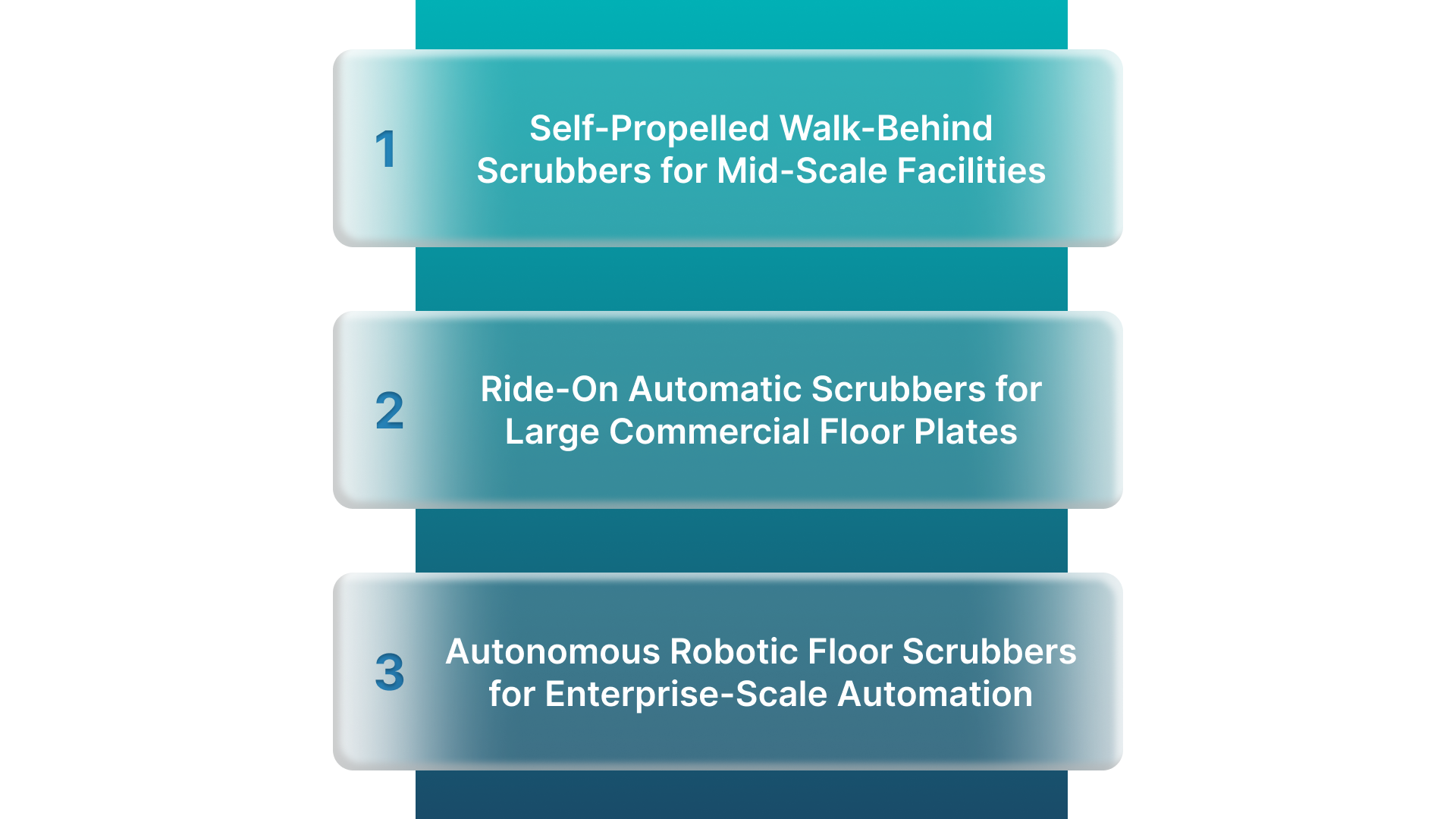
Self-Propelled Walk-Behind Scrubbers for Mid-Scale Facilities
These machines automate scrubbing mechanics while retaining human interaction. They suit facilities with moderate foot traffic and limited floor area.
Operator-Guided Control: Staff steer the unit while automated systems manage brush pressure and solution flow
Reduced Physical Strain: Powered traction lowers operator fatigue during extended cleaning cycles
Moderate Coverage Rates: Throughput supports cafes, clinics, and small retail formats
Labor Dependency: Continuous staffing remains necessary during all operating hours
Use Case:
Ideal for clinics, small retail stores, schools, and office buildings with predictable layouts. These machines support daily scheduled cleaning where human oversight is available, offering controlled scrubbing on tile, vinyl, and epoxy floors without full automation.
Ride-On Automatic Scrubbers for Large Commercial Floor Plates
Ride-on scrubbers increase productivity by combining automation with seated operation. They support facilities with expansive, uninterrupted floor surfaces.
High-Area Throughput: Seated operation enables faster coverage across malls, airports, and warehouses
Consistent Mechanical Output: Automated brush and recovery systems improve cleaning uniformity
Shift-Based Operation: Productivity depends on operator availability and scheduling discipline
Space Requirements: Turning radius limits use in dense or narrow layouts
Use Case:
Best suited for warehouses, airports, convention centers, and large shopping malls. Ride-on scrubbers maximize coverage speed and tank capacity, enabling operators to clean thousands of square meters efficiently during off-hours or low-traffic windows.
Autonomous Robotic Floor Scrubbers for Enterprise-Scale Automation
Robotic scrubbers eliminate manual maneuvering through autonomous decision-making. They operate as part of automated commercial robotics services.
Autonomous Navigation: LiDAR, SLAM, and vision sensors enable self-mapping and obstacle avoidance
Scheduled Operation: Machines run during off-peak or live hours without supervision
Labor Cost Reduction: Automation offsets chronic staffing shortages in service industries
System Integration: Platforms connect with building management and fleet analytics tools
Use Case:
Designed for hospitals, hotels, transit hubs, and multi-site retail chains requiring 24/7, contact-free cleaning. These robots operate autonomously across mixed floor types, delivering repeatable cleaning cycles, real-time monitoring, and reduced labor dependency at scale.
How Automatic Floor Scrubbers Improve Cleaning Efficiency
Automatic floor scrubbers deliver measurable efficiency gains by restructuring how facilities manage repetitive cleaning tasks. They replace labor-intensive workflows with deterministic, machine-controlled processes suited for continuous operations.
Key operational benefits for commercial environments:
Labor Cost Optimization: Automated scrubbing reduces reliance on scarce frontline staff during peak service hours
Consistent Cleaning Standards: Sensor-regulated pressure and solution delivery eliminate human variability
Higher Cleaning Throughput: Machines cover more square footage per hour than manual alternatives
Predictable Scheduling: Predefined routes enable cleaning during off-hours or live operations
Improved Safety Outcomes: Immediate water recovery minimizes slip hazards in public-facing spaces
In hospitals and assisted living facilities, automation supports infection control protocols through repeatable sanitation cycles. In restaurants and retail centers, scrubbers maintain visual cleanliness without diverting staff from customer engagement. For airports and office campuses, automation sustains cleanliness across extended operating hours.
Now, let's see why floor scrubbers outperform traditional manual cleaning in busy facilities.
15 Reasons to Opt for Floor Scrubbers Over Manual Cleaning
Manual floor cleaning methods fail to scale across large, continuously occupied facilities. High labor dependency, physical fatigue, and inconsistent coverage create operational risk. Robotic floor scrubbers convert cleaning into a controlled, repeatable system aligned with automated commercial robotics services.
Cuts Down Labor Cost
Labor accounts for the majority of floor maintenance expenses in service-driven industries. Manual cleaning consumes staff hours that could support revenue, patient care, or customer engagement. Labor shortages and turnover further increase cost volatility in hospitality, healthcare, and retail environments.
Why Robotic Floor Scrubbers Outperform Manual Models
Machine Throughput: Small scrubbers clean 13,000 square feet per hour
Industrial Capacity: Large scrubbers reach 50,000–100,000 square feet per hour
Time Compression: Tasks requiring 20 labor hours are completed in a single automated cycle
Productivity Uplift: Ride-on scrubbers improve productivity by up to 400 percent
Ergonomic Benefit: Upright operation reduces fatigue and injury-related downtime
Efficiently Cleans Large Spaces
Large commercial facilities require uniform coverage across expansive floor plates. Manual cleaning introduces missed zones, uneven dwell time, and inconsistent overlap under spatial pressure. Robotic scrubbers maintain performance regardless of area size or operating hours.
Why Robotic Floor Scrubbers Outperform Manual Models
Wide Cleaning Paths: Larger brush decks increase square-foot-per-hour output
Sustained Speed: Machines operate at optimal velocity without fatigue
Coverage Accuracy: Autonomous routing prevents overlap gaps
Extended Operation: Systems clean during off-hours or live business periods
Easy to Use and Operate
Manual cleaning demands training, physical endurance, and constant supervision. High employee turnover increases onboarding costs and reduces consistency. Robotic floor scrubbers simplify operations by shifting staff roles from execution to oversight.
Why Robotic Floor Scrubbers Outperform Manual Models
Autonomous Route Planning: Systems generate optimized cleaning paths
Reduced Training Burden: Staff supervise instead of performing physical labor
Adaptive Cleaning Modes: Output adjusts based on detected surface conditions
Remote Oversight: Central dashboards support multi-site management
Safe and Quick Drying Time
Wet floors present safety and liability risks in public-facing environments. Manual methods often leave uneven moisture and extend downtime. Robotic scrubbers precisely control water application and recovery.
Why Robotic Floor Scrubbers Outperform Manual Models
Immediate Water Recovery: Integrated vacuum systems remove moisture instantly
Controlled Dispensing: Precision spraying prevents over-saturation
Rapid Drying Cycles: Floors reopen faster during business hours
Risk Reduction: Consistent drying improves compliance and safety scores
Surface Versatility
Commercial facilities operate across multiple flooring materials within the same footprint. Manual cleaning methods struggle to adapt pressure, moisture, and agitation across surfaces. This creates wear risks and inconsistent cleanliness outcomes in high-traffic zones.
Why Robotic Floor Scrubbers Outperform Manual Models
Multi-Surface Compatibility: Supports tile, vinyl, concrete, marble, and sealed wood
Automatic Mode Switching: Adjusts brush pressure and suction by surface type
Material Protection: Reduces abrasion and long-term floor damage
Operational Flexibility: Handles mixed flooring common in hospitals and malls
Performance in High-Traffic Areas
Peak foot traffic disrupts manual cleaning schedules and reduces coverage quality. Human operators avoid congested zones or rush tasks under time pressure. Robotic scrubbers maintain performance consistency regardless of traffic density.
Why Robotic Floor Scrubbers Outperform Manual Models
Traffic-Aware Navigation: Adjusts speed near pedestrians and obstacles
Continuous Operation: Maintains cleaning cycles during business hours
Consistent Coverage: Prevents skipped areas during peak periods
Public-Safe Design: Predictable movement improves customer trust
Smarter Cleaning With Real-Time Data
Manual cleaning lacks visibility into performance and completion metrics. Facility managers cannot verify coverage, frequency, or quality without physical inspection. Robotic scrubbers convert cleaning into a measurable, auditable process.
Why Robotic Floor Scrubbers Outperform Manual Models
Operational Telemetry: Tracks runtime, coverage area, and completion status
Compliance Reporting: Supports healthcare and food safety audits
Remote Monitoring: Enables centralized oversight across multiple sites
Data-Driven Optimization: Improves scheduling and resource allocation
Coverage and Speed Optimization
Coverage speed directly determines cleaning frequency in large facilities. Manual methods cannot sustain the required square-foot-per-hour output. Robotic scrubbers maximize usable cleaning time and spatial efficiency.
Why Robotic Floor Scrubbers Outperform Manual Models
Larger Cleaning Paths: Wide scrub decks increase pass efficiency
Optimized Routing: Algorithms minimize redundant movement
Sustained Velocity: Machines maintain consistent speed across shifts
Higher Throughput: Enables more frequent cleaning cycles
Technological Breakthroughs in Navigation Accuracy
Large commercial environments contain reflective surfaces, strong lighting, and signal interference. These conditions degrade single-sensor navigation reliability. Robotic floor scrubbers now overcome these challenges through advanced perception architectures.
Why Robotic Floor Scrubbers Outperform Manual Models
Multi-Sensor Fusion Architecture: LiDAR, visual navigation, and edge computing work together to maintain accurate positioning in complex indoor environments.
Reflection Error Mitigation: Glass curtain walls and mirror surfaces no longer cause route deviation due to improved environmental modeling.
Autonomous Path Planning: Intelligent routing ensures complete coverage in dense retail, airport, and hospital layouts.
Measured Efficiency Gain: Cleaning efficiency increases by approximately 40 percent when LiDAR navigation replaces manual cleaning workflows.
Battery Life and Operational Continuity
Battery endurance directly impacts cleaning continuity in large facilities. Earlier robotic systems required frequent recharging that disrupted operations. Modern energy systems now support sustained commercial use.
Why Robotic Floor Scrubbers Outperform Manual Models
Commercial Runtime Capacity: Medium-sized robotic scrubbers operate for two to three hours per charge under continuous-duty conditions.
Operational Disruption Evidence: Airport testing showed earlier units required up to four charging sessions per day.
Solid-State Battery Advancement: Emerging battery chemistries increase energy density while reducing long-term degradation.
Automated Charging Infrastructure: Docking base stations enable unattended recharging and continuous installation cycles.
Industry Chain Maturity and Component Localization
Manufacturing maturity reduces procurement risk and accelerates implementation. Localization of core components has altered cost structures. These improvements directly benefit enterprise-scale buyers.
Why Robotic Floor Scrubbers Outperform Manual Models
Localized LiDAR Production: Navigation sensors now achieve domestic substitution with performance parity to imported components.
Performance Stability: Improved computing power and sensing accuracy increase navigation reliability without added cost.
Supply Chain Resilience: Reduced import dependency stabilizes availability for large-scale commercial rollouts.
Service Network Coverage and Enterprise Support
Post-setup support is essential for operational uptime. Robotic floor scrubbers now benefit from expanded service infrastructure. This coverage improves lifecycle reliability for enterprise users.
Why Robotic Floor Scrubbers Outperform Manual Models
Rapid Response Availability: More cities now support 24-hour on-site service coverage.
Reduced Downtime Risk: Faster service resolution sustains operations in hospitals, airports, and retail centers.
Enterprise Launch Confidence: Robust service networks support nationwide and multi-site rollouts.
Cost Effectiveness and Long-Term Economic Value
Procurement cost once limited robotic scrubber usage. Manufacturing maturity and supply chain optimization now reverse that equation. Long-term operating economics increasingly favor automation.
Why Robotic Floor Scrubbers Outperform Manual Models
Procurement Cost Reduction: Many well-known brands reduced robotic scrubber prices while improving performance.
Labor Replacement Efficiency: A single robotic scrubber replaces the workload of three to five cleaning workers.
Consumable Cost Control: Precision water and chemical dosing eliminates waste common in manual cleaning.
Low Wear Expense: Consumables mainly include low-cost brush discs and absorbent materials.
Policy Support and Industry Standardization
Government policy and regulatory frameworks increasingly support smart cleaning technologies. Standardization improves buyer confidence and eliminates substandard equipment.
Why Robotic Floor Scrubbers Outperform Manual Models
Government Procurement Incentives: Regional programs introduced subsidies for smart cleaning equipment.
Capital Attraction Effect: Policy support attracts investment and accelerates research and development activity.
Market Trust Improvement: Standardization removes low-quality products and strengthens buyer confidence.
Competitive Marketplace and Enterprise Innovation
Leading manufacturers continue to regulate the robotic floor scrubber market through sustained innovation. Cross-industry entrants further accelerate implementation by expanding distribution and system integration.
Why Robotic Floor Scrubbers Outperform Manual Models
R&D Investment Leadership: Top enterprises invest more annual revenue into research and development.
Core Technology Advancement: Continuous improvements target navigation accuracy, cleaning efficiency, and human-machine interaction.
Cross-Industry Expansion: Home appliance leaders bring strong brands, capital, and distribution to the robotics market.
System Integration Capability: App-based control and smart-building integration improve operational coordination.
Manual floor scrubbers depend on operator consistency and available labor. ToDo Robotics helps businesses upgrade from manual cleaning to autonomous floor care by helping deploy proven robotic solutions from leading manufacturers. It distributes autonomous solutions like the CC1, which combines sweeping, scrubbing, vacuuming, and mopping, and the PUDU MT1, an AI-powered sweeper built for 24/7 operation in large, high-traffic facilities.
Next, we’ll look at real-world scenarios where robotic floor scrubbers shine.
Application Scenarios for Robotic Floor Scrubbers
The growing implementation of automatic navigation floor scrubbers has significantly expanded their usability across complex and specialized environments. Compared to traditional machines, they offer stronger adaptability, higher efficiency, and smarter obstacle handling.
Unstructured Terrain Adaptation
Conventional floor scrubbers struggle in environments with uneven surfaces, multiple obstacles, slopes, or mixed materials. Automatic navigation floor scrubbers overcome these challenges through sensors and intelligent path-planning algorithms.
Hospital Ward Environments: Floor scrubbers equipped with LiDAR can detect narrow spaces as low as 15 cm beneath hospital beds. By automatically adjusting body height and navigation paths, they effectively clean areas that are typically blind spots in manual cleaning, improving overall hygiene standards.
Warehouse and Logistics Facilities: In warehouses with uneven floors and shifting obstacles, intelligent floor scrubbers use advanced algorithms to plan optimal cleaning routes. This enables stable operation on irregular surfaces while achieving cleaning efficiency up to three times higher than manual cleaning.
Industry-Customized Solutions
Automatic navigation floor scrubbers are increasingly designed for industry-specific requirements, ensuring compliance, safety, and performance.
Food Processing Industry: Machines built with food-grade stainless steel bodies and antibacterial roller brushes meet FDA certification standards, enabling direct cleaning of production floors without cross-contamination risks.
Electronic Manufacturing Industry: Specialized anti-static floor scrubbers control static electricity levels below 100 V through proprietary material design, meeting the strict requirements of dust-free and precision manufacturing workshops.
Elderly Care Institutions: Equipment noise levels are reduced to below 55 decibels, minimizing disturbance to residents while maintaining effective cleaning, making them suitable for quiet, long-duration operation in care facilities.
Now, we’ll discuss how to choose the right floor scrubber for your facility.
How to Choose a Suitable Floor Scrubber
Selecting the right floor scrubber requires evaluating both cleaning performance and practical usability. The following factors are key.
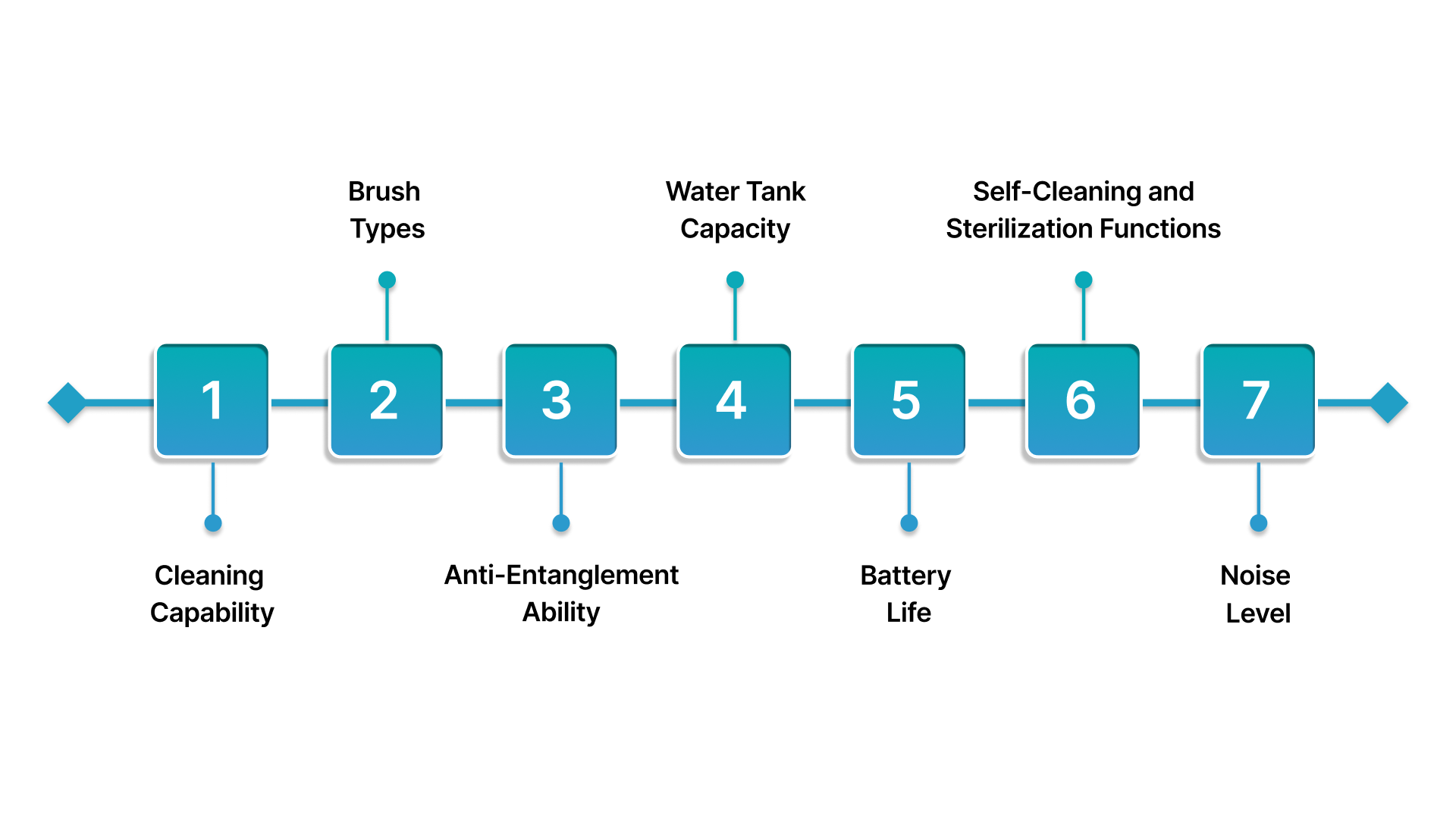
Cleaning Capability
Cleaning performance is the most significant consideration and primarily depends on suction power and brush design.
High suction helps remove large debris effectively.
Quality roller brushes resist hair entanglement and improve durability.
Check floor compatibility carefully; some machines only clean tiles, while others support wood, laminate, and carpets. Multi-surface compatibility offers better long-term value.
Brush Types
Floor scrubbers typically use disc brushes or roller brushes, each suited to different tasks:
Disc Brushes
Large ground contact area and higher downward pressure
Thorough cleaning performance
Compatible with hard brushes, soft brushes, and scouring pads
Suitable for a wide range of floor materials
Roller Brushes
Similar working principle to roller sweepers
Can pick up larger debris while cleaning
Higher rotation speed and better materials improve efficiency and lifespan
Anti-Entanglement Ability
Hair entanglement, especially long hair, can block suction channels and disrupt operation. Floor scrubbers with anti-entanglement technology reduce manual maintenance and ensure consistent performance. This feature is particularly important for households and commercial spaces with frequent hair debris.
Water Tank Capacity
Floor scrubbers usually include separate clean-water and sewage tanks, preventing secondary contamination.
The clean-water tank supplies fresh water during mopping.
The sewage tank collects dirty water and debris.
Larger tank capacity allows longer cleaning sessions and supports larger areas. Regular rinsing is essential, as sludge accumulation can cause odors if left unattended.
Intelligence and Smart Features
Modern floor scrubbers offer enhanced intelligence through:
Voice prompts and real-time gear display
APP-based monitoring and control
Automatic alerts such as “sewage tank full” or “low battery.”
Higher intelligence improves comfort, maintenance, and fault management. However, for households with elderly users or limited familiarity with smart controls, simpler models can still meet basic cleaning needs.
Battery Life
Battery performance directly affects cleaning coverage.
For homes around 120 m², a battery capacity of approximately 2500 mAh is sufficient.
Charging time typically ranges from 4–8 hours, with runtimes between 30–80 minutes, depending on mode.
Wired vs Wireless:
Wired models offer stronger power and lower cost.
Wireless models provide greater flexibility and ease of use for larger spaces.
Choose based on area size, socket availability, and ease of movement.
Self-Cleaning and Sterilization Functions
Self-cleaning is highly recommended. One-button self-cleaning systems wash internal components automatically, requiring only sewage tank disposal afterward. Without this feature, manual cleaning becomes time-consuming. UV sterilization and high-temperature sterilization provide stronger and safer disinfection results.
Noise Level
Noise above 70 decibels can cause discomfort during prolonged use. Look for floor scrubbers using eddy-current noise reduction technology, which significantly lowers operating noise compared to traditional vacuum cleaners, making them more suitable for home and institutional environments.
Finally, let’s see how ToDo Robotics can help you upgrade from manual labor to fully autonomous floor care.
Upgrade From Manual Labor to Autonomous Floor Care With ToDo Robotics as Your Deployment Partner
Manual floor scrubbing strains labor budgets, delivers inconsistent results, and breaks down during peak traffic hours. Robotic floor scrubbers operate continuously, follow data-driven paths, and maintain cleaning standards without staff fatigue. For high-traffic restaurants, hospitals, casinos, and airports, automation protects service quality while reducing dependency on hard-to-fill roles.
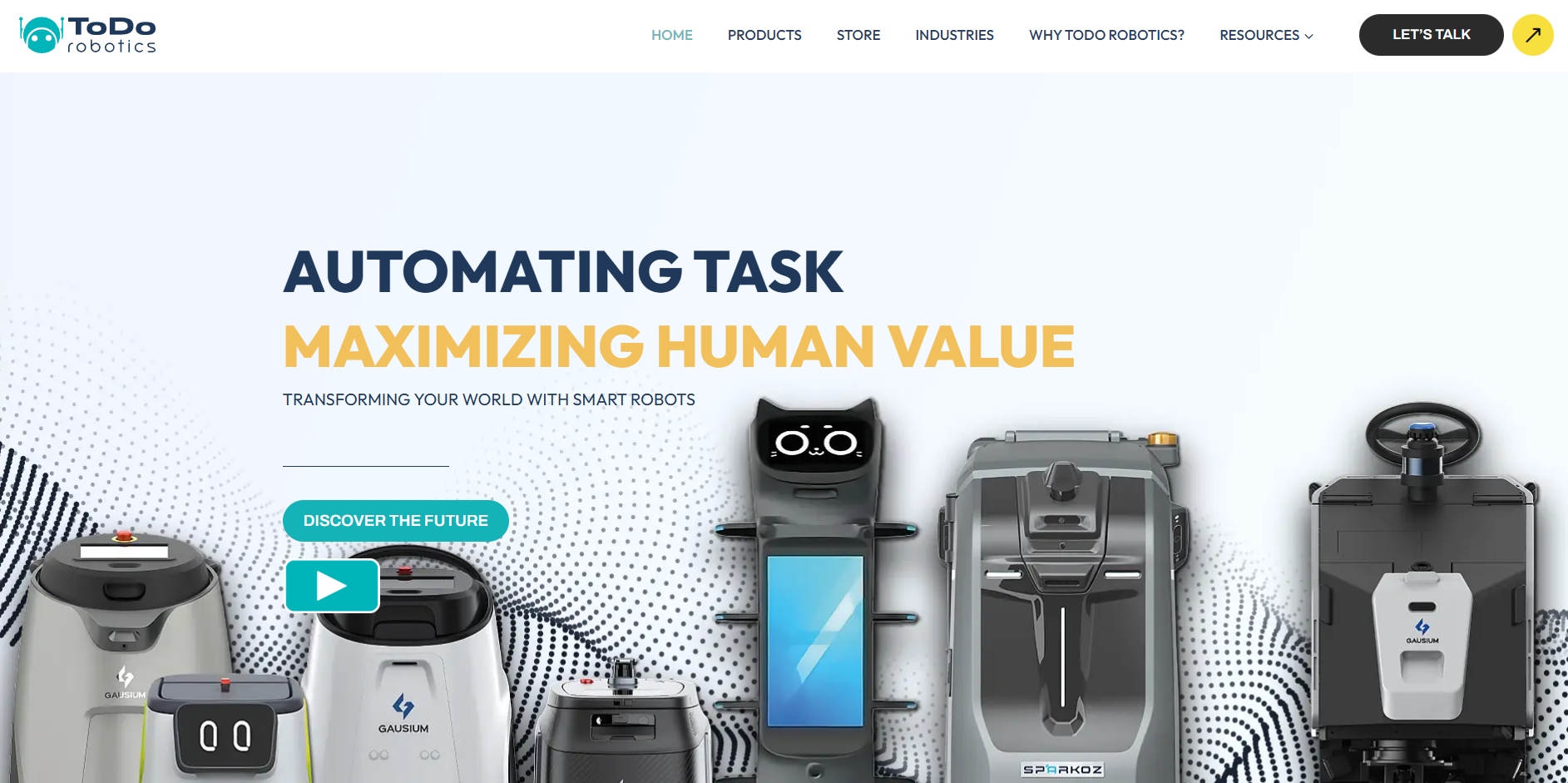
ToDo Robotics enables this shift by helping deploy proven commercial robotics solutions from trusted manufacturers. By acting as a distribution and deployment partner for leading robotics innovators, such as Pudu Robotics and Gausium, ToDo Robotics helps businesses select, integrate, and scale the right autonomous floor-care systems for their operational needs.
CC1 Autonomous Cleaning Robot: CC1 combines sweeping, scrubbing, vacuuming, and mopping into one autonomous platform. It replaces multiple manual tools while adapting to hard floors and low-pile carpets in hospitals and hotels.
PUDU MT1 AI Sweeping Robot: MT1 delivers ride-on sweeper performance without an operator. Its AI vision system supports 24/7 cleaning in casinos, airports, and retail centers with heavy debris loads.
Phantas Compact Floor Cleaning Robot: Phantas handles tight aisles and under-table areas where manual scrubbers slow staff. It supports four cleaning modes, making it ideal for restaurants and cafés with mixed flooring.
Scrubber 50 Autonomous Floor Scrubber: Scrubber 50 uses LiDAR, RGB cameras, and deep-learning algorithms for precision path planning. It outperforms manual scrubbing in crowded commercial environments.
Scrubber 75 (TN70) High-Capacity Scrubber: TN70 delivers industrial-grade pressure and throughput without operator fatigue. It replaces ride-on manual scrubbers in large hospitals, malls, and convention facilities.
PUDU SH1 Upright Scrubber Dryer; SH1 bridges manual mopping and autonomous scrubbing for greasy, slip-prone areas. It ensures consistent results in commercial kitchens, food courts, and hospital corridors.
Vacuum 40 Commercial Vacuum Robot: Vacuum 40 autonomously switches modes based on floor type. It excels in hotel corridors and healthcare facilities with carpet-tile transitions and narrow layouts.
ZACO X1000 Professional Vacuum Robot: X1000 maps spaces using LDS navigation for targeted cleaning coverage. It replaces manual vacuuming while improving hygiene consistency and staff productivity.
Through its robotics distribution, integration, and support services, ToDo Robotics helps businesses transition from manual scrubbers to autonomous systems that protect margins, uphold service standards, and deliver predictable, scalable performance.
Conclusion
Within the ongoing evaluation of manual vs robotic floor scrubbers for businesses, automation clearly aligns with modern operational realities. Commercial facilities no longer evaluate cleaning through manual effort alone. They assess outcomes through efficiency, cost control, consistency, and data visibility. Labor volatility and scale requirements push enterprises toward automation-first strategies.
Robotic floor scrubbers deliver measurable advantages across throughput, safety, and long-term economics. They upgrade repetitive floor care into a predictable, technology-driven operation. This shift directly supports customer experience and compliance outcomes.
Manual scrubbing breaks down during peak hours and staff shortages. ToDo Robotics helps organizations deploy autonomous floor-cleaning robots such as the Scrubber 50, featuring deep-learning path planning, and the TN70 (Scrubber 75), engineered for industrial-scale throughput and sustained cleaning pressure. These proven systems help maintain hygiene standards across multi-location commercial environments without relying on manual consistency.
Contact ToDo Robotics to learn how autonomous floor-care solutions from leading robotics manufacturers can replace manual cleaning while integrating smoothly into daily operations.
FAQs
1. How do robotic floor scrubbers handle peak-hour foot traffic without disrupting operations?
Robotic scrubbers use traffic-aware navigation and adaptive speed control to clean efficiently while avoiding customers, employees, or equipment in high-traffic periods.
2. Can robotic floor scrubbers integrate with existing facility management software?
Yes, most industrial-grade robotic scrubbers support API integration or cloud dashboards for scheduling, monitoring, and centralized reporting across multi-site operations.
3. How often do commercial robotic floor scrubbers require maintenance?
Routine maintenance is typically weekly for brushes, water tanks, and sensors, with major servicing every 6–12 months, depending on facility size and cleaning frequency.
4. Are robotic scrubbers safe to operate around sensitive hospital equipment?
Yes, advanced scrubbers use low-noise motors, non-marking brushes, and sensor-based collision avoidance to protect sensitive equipment and patient safety in medical environments.
5. What is the average ROI timeline for switching from manual to robotic floor scrubbers?
Facilities often recover investment costs within 12–24 months through labor savings, efficiency gains, and reduced consumable waste in high-footfall operations.