Maintaining pristine floors across high-traffic commercial environments has become increasingly challenging. Hotels, hospitals, shopping malls, and office complexes face continuous footfall, frequent spills, and high cleanliness expectations. Manual cleaning teams often struggle to maintain consistent service quality, especially during peak hours, resulting in uneven coverage and staff burnout.
Labor shortages and rising wage costs exacerbate these challenges, making automated solutions a convenience and a strategic operational necessity. Labor shortages and rising wages have turned automation into a strategic requirement rather than a convenience. In response, cleaning robot manufacturers are focusing on multi-surface cleaning capabilities and improved battery performance to strengthen market competitiveness, enabling longer runtimes and broader floor coverage.
In this article, we explore the key features of commercial robots multi-surface cleaning, intelligent navigation, debris collection, adaptive cleaning modes, and how these systems optimize efficiency for mid-to-large commercial operations in 2026.
Key Takeaways
AI-driven navigation and hybrid optimization maximize coverage, reduce cleaning time, and lower labor dependency in high-traffic commercial spaces.
Robots autonomously adjust cleaning modes for tiles, hardwood, laminate, and carpets, ensuring consistent results across multi-surface environments.
Connected fleets improve coverage in large facilities, prevent redundant cleaning, and enhance overall operational productivity.
Energy-efficient motors, intelligent battery management, and recyclable components reduce costs and support sustainability goals.
High-traffic hospitality, healthcare, retail, and commercial real estate facilities achieve predictable performance, hygiene, and measurable cost efficiency.
What Are Commercial Multi-Surface Cleaning Robots?
Commercial multi-surface cleaning robots are autonomous machines built to handle diverse floor types, from carpet and tile to wood and laminate, across high-traffic environments. Equipped with smart navigation, adaptive cleaning modes, and obstacle detection, they ensure thorough coverage with minimal human effort.
7 Key Features of Commercial Robots for Multi-Surface Cleaning
Commercial multi-surface cleaning robots combine advanced sensors, AI, and versatile mechanisms to deliver safe, efficient, and autonomous floor care in high-traffic spaces.
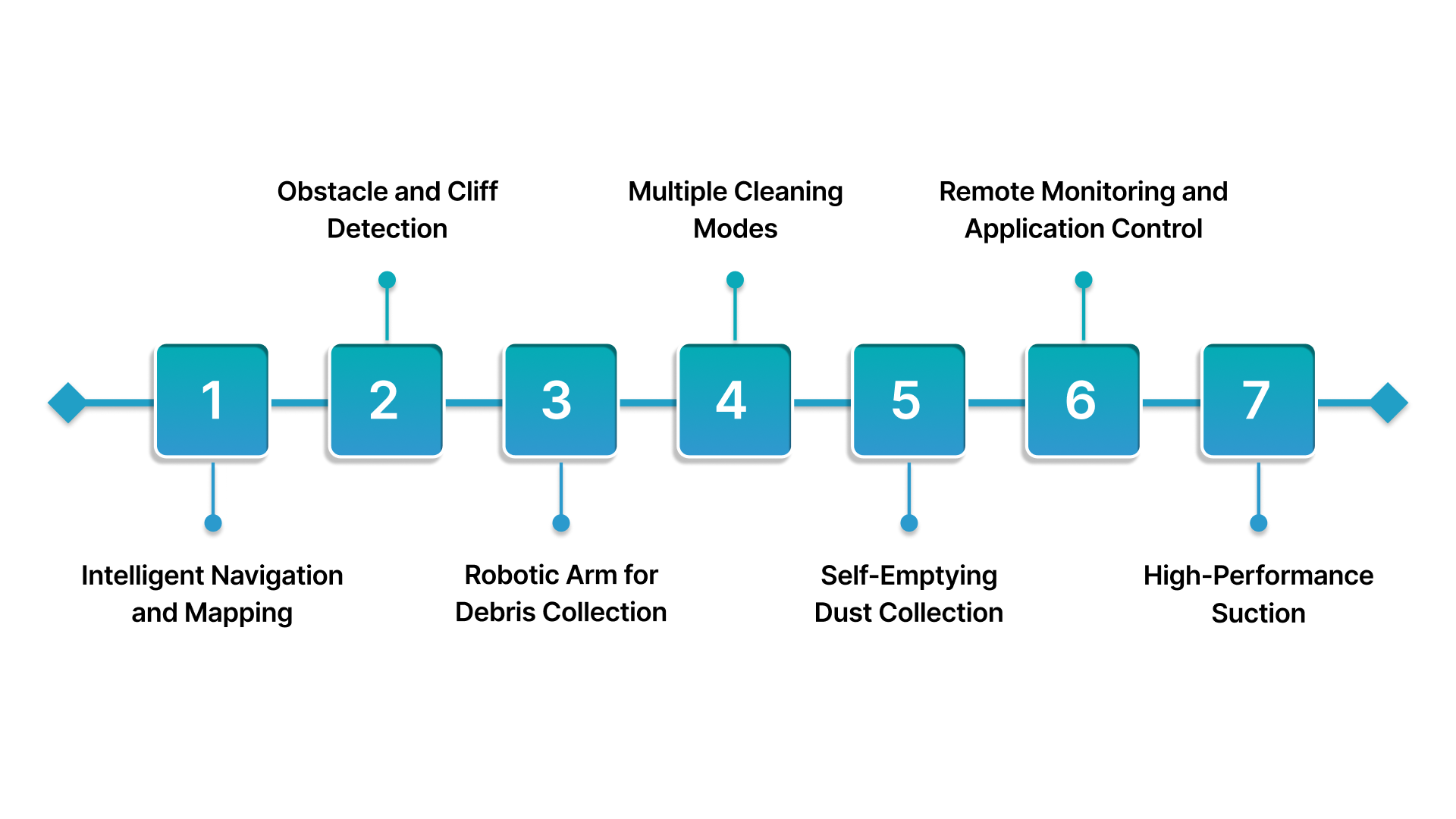
Intelligent Navigation and Mapping
Digital Mapping: Creates real-time 3D maps of rooms, furniture, and obstacles.
Route Planning: Adjusts paths automatically for moving obstacles or layout changes.
Optimized Efficiency: Reduces redundant cleaning and targets high-traffic areas.
Obstacle and Cliff Detection
Collision Prevention: Detects walls, furniture, and equipment to avoid damage.
Stair and Drop Awareness: Prevents falls in multi-level facilities.
Operational Safety: Maintains consistent cleaning while protecting staff and visitors.
Robotic Arm for Debris Collection
Precision Handling: Senses object type, size, and weight to avoid slippage.
Automated Sorting: Separates metal, plastic, and paper debris.
Expanded Functionality: Clears obstructions, reducing manual intervention.
Multiple Cleaning Modes
Surface Adaptability: Works on tile, wood, laminate, and composite floors.
Targeted Cleaning: Spot mode tackles concentrated messes in lobbies or cafeterias.
Edge Cleaning: Cleans corners and perimeters automatically.
Self-Emptying Dust Collection
Autonomous Debris Handling: Minimizes labor across large areas.
Maintenance Reduction: Reduces manual dust disposal.
Operational Continuity: Ideal for hotels, airports, and retail spaces.
Remote Monitoring and Application Control
Task Scheduling: Plan cleaning cycles during off-peak hours.
Progress Monitoring: Track coverage, battery, and maintenance remotely.
Smart System Integration: Works with building automation or facility management software.
High-Performance Suction and Adaptive Intelligence
Consistent Dirt Removal: Powerful suction optimized for floor type.
Adaptive Learning: Learns layouts, dirt patterns, and object positions over time.
Efficiency Optimization: Maximizes coverage in high-footfall areas.
6 Use Cases of Commercial Multi-Surface Cleaning Robots in Different Industries
Commercial multi-surface cleaning robots are used across environments where consistent hygiene, scale, and uptime matter more than manual effort. Their ability to adapt to different floor materials and traffic patterns makes them especially effective in the following scenarios:
Hotels & Hospitality: Used in lobbies, corridors, banquet halls, and back-of-house areas to maintain carpets, tiles, and hard floors throughout the day without disrupting guests.
Hospitals & Healthcare Facilities: Support infection control by delivering repeatable, contact-free cleaning across wards, corridors, ICUs, and waiting areas with precise water and chemical control.
Retail Stores & Shopping Malls: Handle continuous foot traffic, food spills, and mixed flooring by running frequent cleaning cycles during and after operating hours.
Airports & Transit Hubs: Maintain large surface areas with variable flooring types, ensuring uniform coverage across terminals, check-in zones, and walkways.
Office Campuses & Commercial Buildings: Automate routine floor care across open offices, meeting areas, and shared spaces while reducing reliance on night-shift cleaning staff.
Warehouses & Logistics Centers: Clean expansive concrete or epoxy floors around active operations, supporting 24/7 workflows without interrupting material movement.
These use cases highlight how commercial multi-surface cleaning robots shift floor care from a labor-heavy task to a scalable, system-driven operation.
Next, we’ll explore how these robots are categorized for different facility types.
Market Segmentation of Commercial Cleaning Robot for High-Traffic Facilities
The commercial cleaning robot market is segmented by type, product, operation mode, charging method, end user, cleaning function, and level of autonomy. Segmentation highlights how solutions meet diverse commercial requirements.
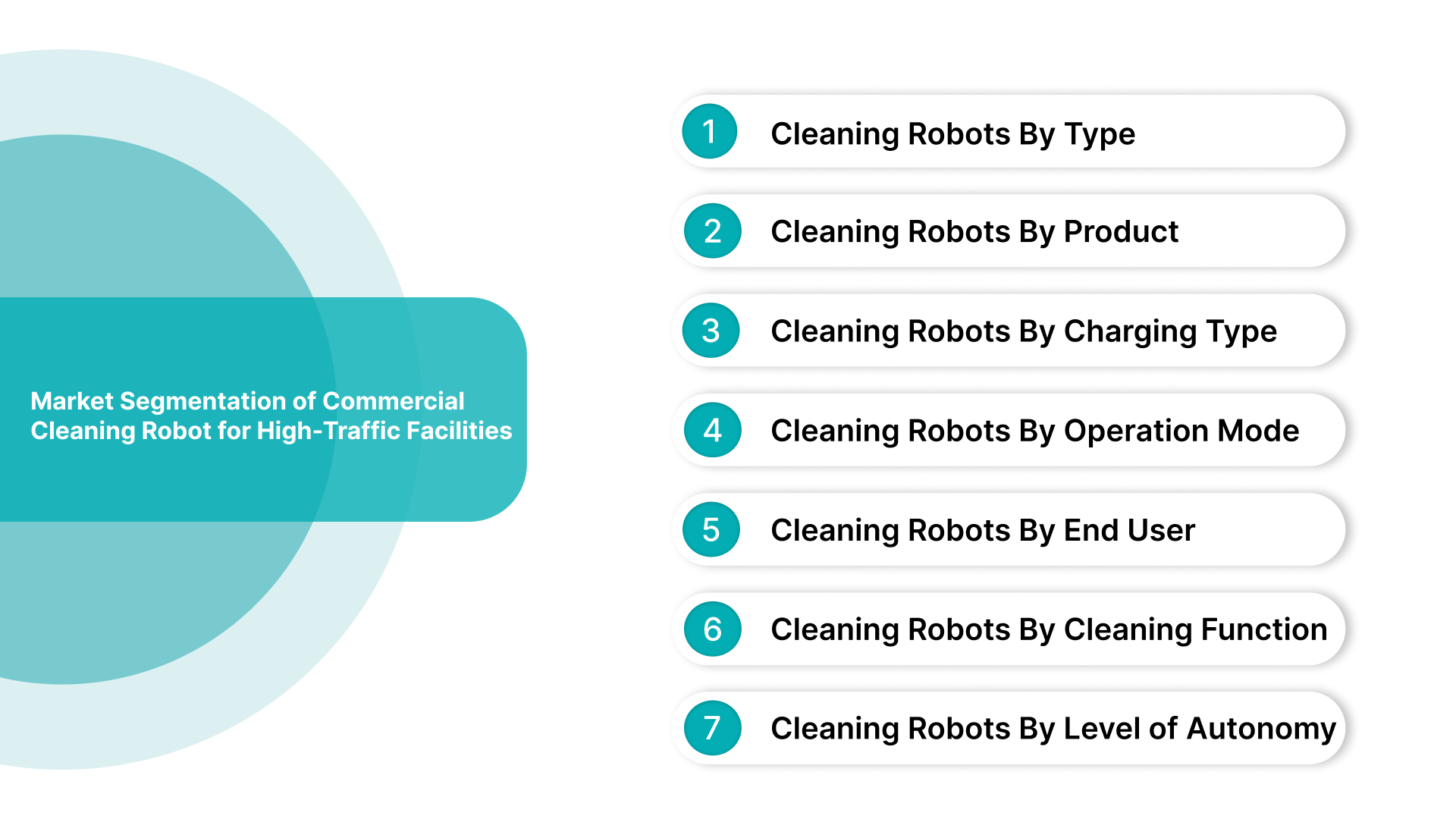
Cleaning Robots By Type
Different cleaning robot types target specialized tasks in commercial and high-traffic environments.
Floor-Cleaning Robots: Core solution for offices, hospitals, hotels, and retail spaces with large hard-surface areas.
Pool-Cleaning Robots: Designed for hotels, resorts, and recreational facilities requiring consistent water hygiene.
Window-Cleaning Robots: Operate on high-rise and multi-level facilities, improving safety and efficiency for glass surfaces.
Lawn-Cleaning Robots: Serve landscaped commercial properties, airports, and campuses, maintaining outdoor areas with minimal labor.
Cleaning Robots By Product
Robots are classified based on operational environment and application scope.
In-House Robots: Designed for indoor surfaces such as tiles, wood, and laminate in offices, hotels, hospitals, and retail chains.
Outdoor Robots: Built for uneven surfaces, lawns, and open-air public spaces, offering durability and weather resistance.
Cleaning Robots By Charging Type
Power management influences operational continuity and labor optimization in commercial facilities.
Automatic Charging: Robots autonomously return to docks, minimizing downtime and reducing staff supervision.
Manual Charging: Requires operator intervention, suitable for smaller facilities with predictable cleaning schedules.
Cleaning Robots By Operation Mode
Operational flexibility supports integration into facility management workflows.
Self-Drive Robots: Navigate autonomously using AI, LiDAR, and sensor fusion, ideal for large, high-traffic areas.
Remote-Controlled Robots: Enable targeted cleaning for precise tasks, useful in sensitive zones or special-event scenarios.
Cleaning Robots By End User
Key users prioritize efficiency, consistency, and cost reduction.
Facility Management Companies: Represent the largest segment, managing diverse properties with labor-efficient solutions.
Hospitality Sector: Hotels, resorts, and food courts utilize robots for high hygiene standards and guest experience enhancement.
Healthcare Institutions: Hospitals and wellness centers utilize automated cleaning to reduce cross-contamination and improve operational reliability.
Retail Chains: Shopping centers and supermarkets rely on robots to maintain clean floors across large, complex layouts.
Facility management companies drive implementation due to the need for scalable, repeatable cleaning solutions. Robots reduce labor dependency, allow staff to focus on specialized tasks, and increase overall productivity.
Cleaning Robots By Cleaning Function
Automation efficiency varies by function, targeting high-frequency or essential hygiene tasks.
Floor Scrubbing & Sweeping: Dominant function, essential for daily maintenance in offices, retail, and hospitals.
Window Cleaning: Improves safety and efficiency for high-rise facilities with hard-to-access glass surfaces.
Disinfection & Sanitization: Increasingly important in healthcare and hospitality, integrating UV or chemical systems for microbial control.
Floor scrubbing leads to high-frequency, measurable efficiency gains, and compatibility with AI-driven navigation for consistent results.
Cleaning Robots By Level of Autonomy
Autonomy determines labor savings, scalability, and operational reliability.
Fully Autonomous Robots: Operate independently, perform path planning, adapt to environmental changes, and recharge automatically.
Semi-Autonomous Robots: Require occasional human guidance or supervision for complex areas.
Remote-Controlled Robots: Operator-driven for targeted or specialized cleaning tasks.
Fully autonomous robots dominate usage due to AI, machine learning, and sensor fusion capabilities. They provide continuous, reliable cleaning, enabling 24/7 operations in large commercial facilities and maximizing ROI.
Now, let’s examine the algorithms that make these robots smarter and more efficient.
6 Advanced Optimization Algorithms for Commercial Cleaning Robots
Modern multifunctional cleaning robots utilize meta-heuristic optimization algorithms to make multi-surface cleaning faster, smarter, and more reliable in high-traffic environments.
Luus–Jaakola Optimization (LJO)
Path Accuracy: Improves trajectory planning for efficient coverage in complex layouts like hospitals, offices, and retail floors.
Parameter Tuning: Optimizes brush speed, suction power, and mopping force for surface-specific cleaning.
Equilibrium Optimizer (EO)
Path Planning: Adjusts routes automatically around moving obstacles or furniture.
Resource Optimization: Balances energy use and cleaning speed for uninterrupted operation.
Random Search Algorithm (RSA)
Adaptive Exploration: Finds optimal cleaning paths in unmapped or changing areas.
Obstacle Avoidance: Recalculates paths around temporary obstacles like carts or trolleys.
Golden Jackal Optimizer (GJO)
Robotic Arm Control: Coordinates multi-joint movement for precise debris pickup.
Task Efficiency: Reduces time handling scattered objects in busy spaces.
African Vulture Optimizer (AVoA) & Archimedes Optimization Algorithm (AOA)
Energy Efficiency: Minimizes battery use while maintaining consistent cleaning.
Coverage Optimization: Ensures complete floor coverage without redundant movements.
Flow Direction Algorithm (FDA)
Adaptive Control: Modifies cleaning patterns and suction in real-time for novel layouts.
Smart Energy Management: Optimizes power for long, multi-hour cleaning cycles.
Integrating these algorithms allows commercial robots to maximize cleaning accuracy, coordinate complex movements, and extend runtime, redefining multi-surface maintenance for hospitals, hotels, retail, and other high-traffic facilities.
With smarter algorithms, we can see why market opportunities for these robots are expanding.
8 Market Drivers and Opportunities for Commercial Cleaning Robots
The commercial cleaning robot market is advancing steadily, driven by AI, multi-surface capability, multifunctional designs, sustainability trends, and usage in high-traffic facilities like hospitals, hotels, warehouses, and retail centers.
AI and Machine Learning Integration
AI and machine learning enhance navigation, task precision, and adaptive cleaning across different floor types, from tiles to carpet, in hospitals, warehouses, and retail spaces.
Optimized Multi-Surface Coverage: AI-driven navigation adapts cleaning paths for mixed flooring in hotels, hospitals, and shopping centers.
Labor Efficiency: Robots operate autonomously across multiple surfaces, letting staff focus on specialized tasks.
Operational Reliability: Hospitals report reduced infection rates thanks to consistent cleaning on all floor types.
Shift Toward All-in-One Solutions
Modern robots combine sweeping, scrubbing, vacuuming, and mopping into a single compact unit, handling hard and soft floors in one pass.
Versatility Across Surfaces: Works seamlessly on tile, hardwood, laminate, and carpet in high-traffic commercial areas.
Space-Efficient Design: Perfect for corridors, lobbies, and compact service areas with mixed flooring.
Multi-Functional Operation: Reduces the need for multiple machines, lowering costs and simplifying maintenance.
Advanced Navigation and Sustainability
Integrated LiDAR, ultrasonic sensors, AI cameras, and adaptive battery systems enable precise cleaning paths across varied floor types while conserving energy.
Adaptive Multi-Surface Paths: Adjusts cleaning routes and intensity for different floors in real-time.
Energy Management: Optimized motors and batteries allow extended operation on large, mixed-floor areas.
Sustainability Compliance: Uses eco-friendly materials and energy-efficient designs for low environmental impact.
Emerging Application Areas
Multi-surface robots are increasingly used in spaces with diverse flooring, including warehouses, schools, hospitals, airports, and hotels.
High-Density Facilities: Cleans mixed-floor areas continuously in warehouses and airports.
Education & Public Spaces: Maintains hygiene across tile, vinyl, and carpeted surfaces with minimal staff input.
Industry-Specific Application: Hospitals, hotels, and retail centers utilize robots for consistent, multi-floor hygiene and efficiency.
Integration with Smart Building Systems
IoT-enabled cleaning robots synchronize with building management systems, optimizing routes and cleaning intensity for different floor types.
Facility Management Integration: Supports smart building systems with adaptive multi-floor cleaning.
Data-Driven Optimization: Tracks cleaning performance and floor-type coverage for better resource allocation.
Enhanced Value: Enables preventive maintenance and ensures efficient cleaning across all surfaces.
Robotics-as-a-Service (RaaS) and Infrastructure Growth
RaaS and growing infrastructure demand allow easy installation of robots capable of multi-surface cleaning in large campuses, hospitals, and multi-floor facilities.
Flexible Installation Models: Cost-effective access to robots capable of sweeping, scrubbing, and mopping multiple surfaces.
Scalable Operations: Handles multi-floor and mixed-surface buildings efficiently.
Infrastructure Alignment: Matches growth in smart buildings and high-traffic multi-surface areas.
Surge in E-Commerce and Warehouse Automation
E-commerce growth requires cleaning robots that can maintain hygiene across varied floor types in large-scale logistics and storage facilities.
High-Footfall Logistics: Ensures continuous cleaning on concrete, epoxy, and tiled warehouse floors.
Labor Shortage Mitigation: Reduces reliance on temporary staff for multi-floor cleaning tasks.
Operational Continuity: Supports multi-shift operations with reliable, adaptable cleaning across surface types.
Government Incentives
Policies and grants encourage the use of multi-surface cleaning robots, improving hygiene and operational efficiency in commercial facilities.
Policy Support: Reduces cost barriers for large facilities needing multi-surface cleaning automation.
Smart Facility Enablement: Encourages AI-enabled robots for diverse flooring in logistics, hospitality, and healthcare.
By partnering with leading robotics manufacturers, ToDo Robotics helps facilities implement platforms such as the PUDU CC1 for combined sweeping and scrubbing across varied surfaces, and the MT1 for maintaining large public areas using AI-based visual recognition that allows continuous operation even during peak foot traffic.
Next, it’s important to understand the barriers facilities face.
5 Industry Restraints on Multi-Surface Commercial Cleaning Robot Implementation
Despite rapid technological advances, several barriers continue to limit the utilization of multi-surface commercial cleaning robots in high-traffic facilities like hotels, hospitals, retail centers, and airports.
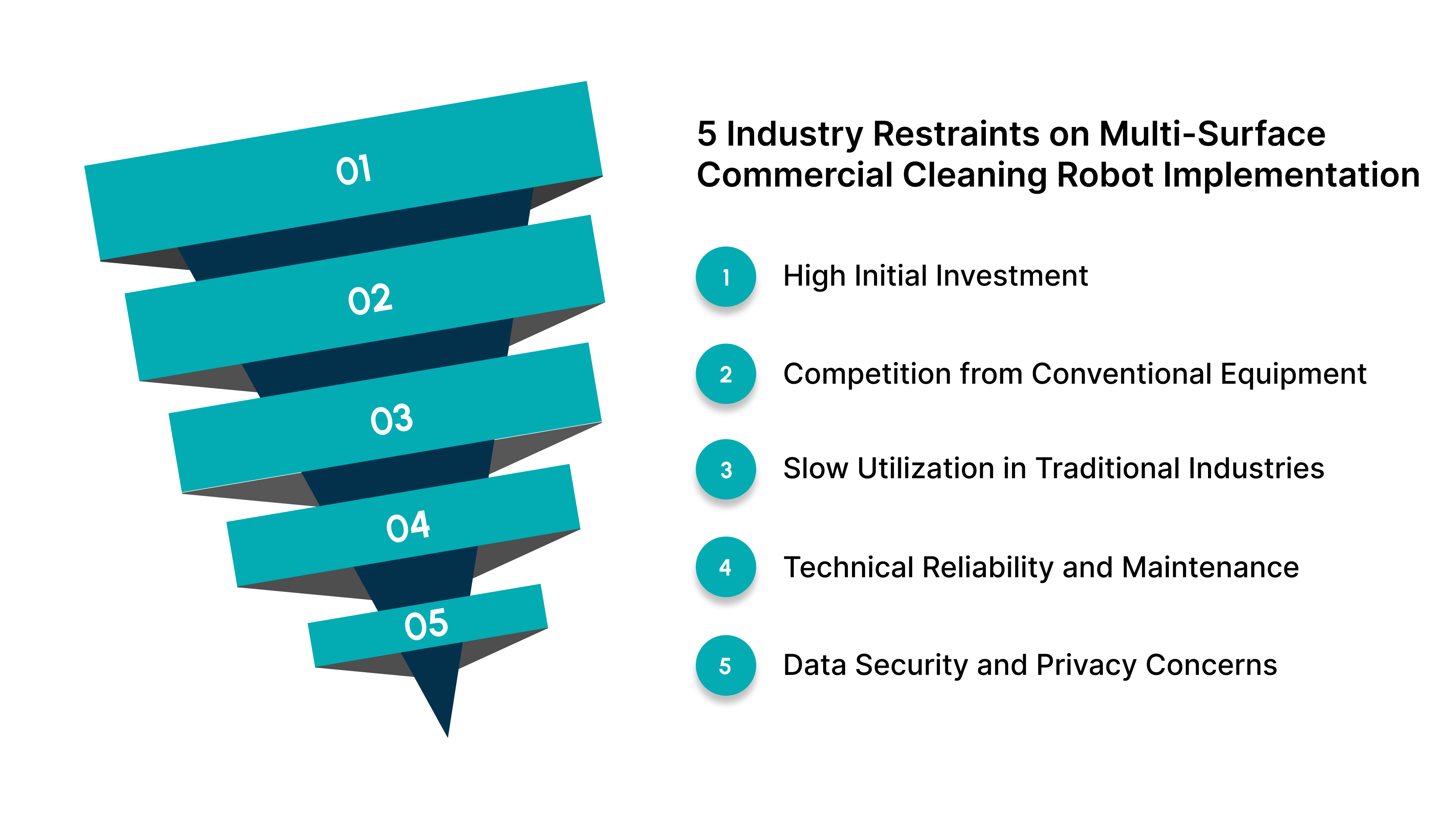
High Initial Investment
The upfront cost of autonomous multi-surface cleaning robots, often around $12,000 versus $3,000 for conventional scrubbers, can restrict use for smaller and mid-sized enterprises.
Capital Sensitivity: Facilities in hospitality, retail, and healthcare with mixed-floor environments may opt for lower-cost manual solutions.
ROI Timing: Even with long-term efficiency across multiple surface types, upfront capital hesitancy delays implementation.
Competition from Conventional Equipment
Ride-on and walk-behind scrubbers remain common due to affordability, accessibility, and minimal training requirements, limiting robotic uptake.
Entrenched Practices: Facilities with established workflows may resist replacing familiar multi-surface manual equipment.
Cost-Driven Choices: Lower upfront costs of traditional machines appeal to budget-conscious operations, even if they cannot efficiently handle multiple flooring types.
Slow Utilization in Traditional Industries
Industries reliant on conventional cleaning contracts and legacy methods exhibit slower uptake, skeptical of robots’ ability to replicate nuanced multi-surface cleaning.
Operational Inertia: Resistance to workflow changes slows integration of autonomous cleaners across mixed-floor environments.
Human Cleaning Nuances: Some facilities perceive robots as less effective on intricate tasks or high-touch areas spanning tile, carpet, and wood.
Technical Reliability and Maintenance
Commercial robots still face challenges in cluttered or complex layouts, affecting performance on multiple floor types and requiring occasional human oversight.
Complex Environments: Crowded retail aisles or densely furnished offices can hinder multi-surface navigation.
Maintenance Dependency: Sensor calibration, software updates, and occasional repairs demand technical expertise to maintain consistent cleaning across floors.
Data Security and Privacy Concerns
Integration with IoT systems and building management software raises concerns about data security, particularly when robots monitor activity across large multi-surface areas.
Connectivity Risks: Networked robots could expose sensitive operational data if not properly secured.
Compliance Requirements: Facilities must adhere to local regulations on data collection, storage, and monitoring for mixed-floor operations.
Looking ahead, let’s consider the innovations influencing the future of multi-surface cleaning robots.
8 Future Trends in Commercial Multi-Surface Cleaning Robots
The commercial cleaning robotics sector in 2026 is driven by advances in AI, sensor fusion, and autonomous systems. These innovations change how large facilities manage cleanliness, labor, and operational efficiency.
AI‑Enhanced Autonomous Navigation
AI and machine learning will further improve robot navigation in complex, high‑traffic environments. Neural networks and probabilistic mapping enable robots to adapt to floor layouts in real time.
Predictive Movement Models: Robots learn recurring foot‑traffic patterns to avoid congestion and optimize cleaning cycles.
Real‑Time Path Optimization: Deep learning enhances route planning amid changes in furniture or crowd flow.
Semantic Scene Understanding: Robots differentiate between static structures and moving obstacles to improve safety.
Hybrid Optimization Strategies
Researchers are embedding hybrid meta‑heuristic algorithms into control systems to balance speed, energy usage, and coverage precision. Robots become more resilient and efficient in multi‑surface commercial contexts.
Multi‑Objective Optimization: Balances energy consumption with path coverage and cleaning intensity.
Adaptive Parameter Tuning: Robots adjust operational parameters in response to environmental feedback.
Reduced Computational Latency: Edge‑processing accelerates decision‑making on board, lowering dependence on cloud processing.
Swarm Coordination and Fleet Intelligence
Connected cleaning robot fleets in large facilities like airports and shopping malls enable coordinated multi‑unit operations. Swarm intelligence improves coverage and reduces redundant cleaning routes.
Collaborative Task Allocation: Robots assign zones cooperatively to maximize throughput.
Centralized Fleet Analytics: Facility managers monitor performance across multiple robots in real time.
Workload Balancing: Systems redistribute tasks based on individual robot status and battery levels.
Human-Robot Collaboration Interfaces
Future robots will enhance staff collaboration through intuitive interfaces, voice assistance, and shared control paradigms. This reduces operational friction in facilities with limited robotics expertise.
Conversational Control Panels: Natural language interfaces simplify task assignment for non‑technical staff.
Augmented Visualization: AR dashboards help supervisors assess coverage and robot status at a glance.
Interactive Overrides: Operators intervene manually when needed without disrupting autonomous routines.
Regulatory and Safety Standardization
As usage grows, industry standards develop to ensure safety, interoperability, and compliance in commercial environments. Robotics certification frameworks emerge alongside guidelines.
Industry‑Wide Standards: Safety benchmarks for autonomous cleaning systems become widely utilized.
Interoperability Protocols: Robots integrate seamlessly with building management systems (BMS).
Certification Programs: Safety and performance certifications build buyer trust.
Commercial ROI and Workforce Augmentation
Future implementation in hospitality, retail, healthcare, and commercial real estate will focus on long‑term operational ROI and workforce optimization strategies rather than headcount replacement.
Labor Reallocation: Staff spend more time on guest engagement, patient care, and customer service.
Operational Savings Metrics: Facilities benchmark robotics impact using uptime, cost per square foot, and hygiene scores.
Predictive Maintenance: Machine learning forecasts component wear, reducing downtime.
In 2026, commercial cleaning robots will no longer be niche tools but essential elements of facility operations. Leaders in high‑traffic sectors will prioritize autonomous systems for efficiency, consistency, and enhanced customer experience.
With these advancements in mind, here’s why top facilities are choosing ToDo Robotics.
Why High-Traffic Facilities Choose ToDo Robotics as a Trusted Distributor for Multi-Surface Cleaning Solutions
In 2026, commercial facilities require cleaning systems that perform across mixed floor types without increasing labor pressure. As a distributor and deployment partner for robotics leaders such as Pudu Robotics and Gausium, ToDo Robotics helps organizations implement autonomous, multi-surface cleaning solutions suited for restaurants, hospitals, casinos, airports, and retail spaces with constant foot traffic. This partner-led approach enables businesses to move beyond manual, inconsistent cleaning toward scalable automation.
CC1 Autonomous Cleaning Robot: CC1 combines sweeping, scrubbing, vacuuming, and mopping in one platform for hard floors and low-pile carpets. It supports marble, tile, epoxy, terrazzo, and carpeted areas common in hotels and hospitals.
PUDU MT1 AI Sweeping Robot: MT1 uses multi-sensor fusion and AI visual recognition for continuous 24/7 sweeping in large venues. Its 35-liter trash bin and dual-disc brushes handle debris in airports, malls, and casinos.
Phantas Multi-Surface Cleaning Robot: Phantas supports vacuuming, scrubbing, sweeping, and dust mopping in compact environments. Its small footprint allows effective cleaning under tables and in narrow restaurant aisles.
Scrubber 50 Autonomous Floor Scrubber: Scrubber 50 applies deep-learning algorithms with LiDAR and RGB cameras for adaptive path planning. It delivers precise scrubbing in environments like hospitals and retail corridors.
TN70 / Scrubber 75 Industrial Scrubber: Designed for large commercial spaces, this robot delivers high ground pressure and wide cleaning coverage. It maintains consistent results across warehouses, airports, and convention centers.
PUDU SH1 Upright Scrubber Dryer: SH1 addresses greasy and slippery floors common in commercial kitchens and food courts. It bridges manual mopping and industrial scrubbing for fast, professional floor care.
Vacuum 40 Commercial Vacuum Robot: Vacuum 40 autonomously switches between carpet and hard floor modes using 3D vision. It is optimized for hotel corridors, patient wings, and mixed-surface retail layouts.
ZACO X1000 Professional Vacuum Robot: ZACO X1000 covers up to 1000 square meters with high suction and LDS mapping. It integrates into existing cleaning workflows while freeing staff for higher-value tasks.
Through its distribution and deployment partnerships, ToDo Robotics supports businesses in major NFL cities, including Atlanta, in standardizing cleanliness, reducing labor dependency, and scaling the use of commercial robots for multi-surface cleaning across multi-location operations.
Conclusion
In 2026, commercial robots multi-surface cleaning systems are redefining operational efficiency, ensuring consistent sanitation, and reducing labor dependency across hospitality, healthcare, retail, and commercial real estate sectors.
By combining advanced AI, hybrid optimization algorithms, and fleet coordination, multifunctional cleaning robots operate through complex layouts, handle diverse surfaces, and maintain hygiene standards autonomously. Facilities using these solutions benefit from predictable performance, lower operational costs, and improved customer and occupant experiences while freeing staff for higher-value tasks.
Through its role as a distribution and deployment partner, ToDo Robotics helps operators with autonomous commercial cleaning robots that can be introduced into active facilities without disrupting guests or daily operations. Capabilities such as LiDAR- and RGB-based adaptive navigation, found in platforms like the Scrubber 50, and automatic surface switching between carpet and hard floors, as demonstrated by solutions like the Vacuum 40, are essential in real-world hotel and retail corridors.
Contact ToDo Robotics to learn how autonomous cleaning solutions from leading robotics manufacturers can be integrated into environments similar to yours.
FAQs
1. How do commercial cleaning robots handle multiple floor types in high-traffic areas?
Advanced sensors and adaptive suction/mopping adjust cleaning force for tiles, hardwood, laminate, and carpets, ensuring consistent results in commercial spaces.
2. Can these robots integrate with existing building management systems?
Yes, IoT connectivity allows robots to sync with smart building platforms, enabling optimized routes, maintenance scheduling, and real-time reporting in large facilities.
3. What is the expected operational ROI for mid-to-large facilities?
Robots reduce labor dependency, optimize energy use, and maintain consistent cleaning, delivering measurable cost savings and efficiency improvements in months rather than years.
4. How do robots manage debris that traditional vacuum systems miss?
Multifunctional robots use integrated robotic arms and object recognition sensors to collect small items like coins, paper, or plastic debris without damaging surfaces.
5. Are these systems suitable for hospitals and food-service areas?
Yes, FDA-compliant materials, UV sterilization, and adaptive cleaning modes ensure hygiene and safety standards are met in sensitive commercial environments.