Just a few years ago, many restaurants were still relying on manual or semi-digital workflows, including paper tickets in the kitchen, fragmented ordering systems, limited automation, and heavy dependence on front-of-house staff. While digital tools existed, adoption was often slow and inconsistent across daily operations.
Over the past two years, however, rapid changes in customer behavior, ongoing labor shortages, and rising operating costs have accelerated technology adoption at an unprecedented pace. Restaurants have increasingly embraced data-driven management tools, kitchen automation, and service robotics to maintain speed, consistency, and profitability.
This guide explains how technology has changed restaurants in 2026, highlighting the systems reshaping operations today, and their measurable impact on efficiency and guest experience.
Key Takeaways
Restaurant technology has evolved rapidly in the past two years, shifting from basic digital tools to connected, automation-supported operating systems.
Modern restaurants rely on integrated technology, combining ordering, kitchen management, analytics, and automation to improve speed and consistency.
Automation and robotics now play a practical role in daily operations, supporting staff, reducing physical workload, and stabilizing service during labor shortages.
Data-driven decision-making has become essential, helping operators optimize staffing, inventory, menus, and service flow in real time.
Successful technology adoption requires strategy, not volume, with ROI-focused selection and phased implementation delivering the strongest long-term results.
What Does Technology Look Like For Restaurants In 2026?
In 2026, restaurant technology is no longer made up of isolated tools. Instead, most successful operations rely on connected systems that work together across front of house, kitchen, and management workflows.
The focus has shifted from adopting technology for novelty to using it for measurable efficiency, cost control, and consistency.
Rather than replacing people, technology in modern restaurants is designed to support staff, reduce manual work, and improve decision-making in real time.
Common characteristics of restaurant technology in 2026 include:
Unified digital ecosystems: POS, online ordering, inventory, loyalty, and analytics platforms are increasingly integrated rather than operating as standalone tools.
Mobile-first operations: Managers monitor sales, staffing, and performance from dashboards accessible on tablets and smartphones.
Automation of repetitive tasks: Routine activities such as order routing, inventory updates, and internal food running are handled automatically.
Real-time data visibility: Sales trends, labor costs, and menu performance are tracked continuously, allowing faster operational adjustments.
Flexible service models: Restaurants can easily switch between dine-in, takeout, delivery, and hybrid formats without operational disruption.
Technology is also more visible to guests in 2026. Digital menus, contactless payments, and order tracking have become standard expectations rather than optional features.
At the same time, many innovations now operate quietly in the background:
Kitchen display systems coordinating prep flow
Demand forecasting tools predicting busy periods
Automated scheduling aligned with sales data
Service and delivery robots supporting staff movement
Together, these systems allow restaurants to operate with greater precision, consistency, and resilience, even in the face of staffing challenges and fluctuating demand.
In 2026, restaurant technology is less about adding more tools and more about creating smarter, connected operations that scale without increasing complexity.
Key Technologies Transforming Restaurants in 2026
Over the past two years, restaurant technology has evolved from isolated digital tools into connected operational systems.
Today’s restaurants rely on technology not only to take orders, but to coordinate service flow, manage labor constraints, and maintain consistency during high-volume periods.
The most impactful technologies fall into several core categories:
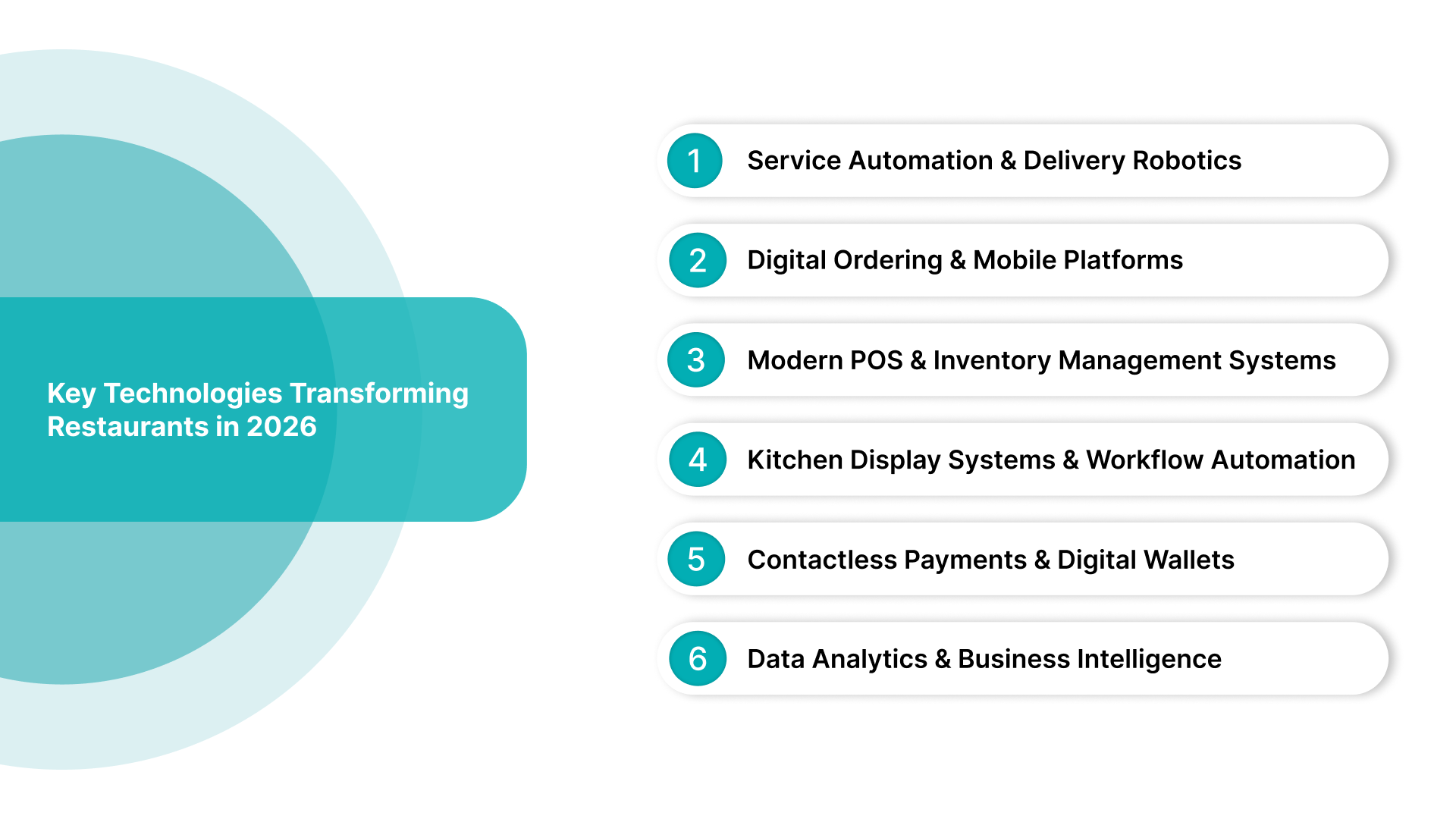
Service Automation And Delivery Robotics
Among all recent technology shifts, service automation has emerged as one of the most impactful transformations in restaurant operations. Unlike digital ordering or payment tools, delivery robotics directly addresses the physical workload that slows service, contributes to burnout, and limits throughput during peak hours.
Especially when labor shortages persist, restaurants increasingly rely on automation to support staff rather than replace them.
Indoor delivery robots are used to:
Transport food from kitchens to tables
Deliver multiple orders simultaneously
Reduce long walking distances for servers
Maintain service speed during understaffed shifts
This allows servers to focus on guest interaction and order accuracy, improves table turnover, and helps maintain consistent service quality without increasing labor costs.
For restaurants evaluating automation, understanding where delivery robots fit within daily service flow is often the first step toward long-term efficiency. ToDo Robotics helps operators assess layout, workflows, and service demand to identify where indoor delivery robots can deliver the greatest impact.
Digital Ordering And Mobile Platforms
Digital ordering has become a foundational layer of modern restaurant operations. Online ordering systems, branded mobile apps, and QR-based menus allow guests to browse menus, customize orders, and place requests without waiting for staff availability.
Common applications include:
Online ordering for dine-in, takeout, and delivery
QR code menus that reduce menu maintenance and printing costs
Self-service kiosks for high-volume environments
Integration with third-party delivery platforms
These tools increase order throughput while reducing pressure on front-of-house teams.
Modern POS And Inventory Management Systems
Point-of-sale systems have shifted from basic transaction tools to centralized operational hubs. Modern POS platforms connect ordering, payments, inventory, and reporting in real time.
Key capabilities include:
Real-time sales tracking across service channels
Automated inventory updates based on menu activity
Ingredient-level cost monitoring
Menu pricing accuracy and margin visibility
This level of visibility allows operators to make faster, data-driven decisions during daily service.
Kitchen Display Systems (KDS) And Workflow Automation
Kitchen display systems have replaced paper tickets in many restaurants, dramatically improving speed and accuracy.
KDS platforms help kitchens:
Route orders automatically to prep stations
Prioritize tickets based on service time
Reduce lost or unreadable paper tickets
Improve communication between front and back of house
When combined with automation technologies, such as service robots that assist with food running, KDS systems help maintain consistent service flow during peak periods.
Contactless Payments And Digital Wallets
Payment technology has also evolved rapidly, with speed and convenience now central to customer expectations.
Common features include:
Tap-to-pay and mobile wallet support
Table-side payment devices
Digital receipts and order confirmation
These systems reduce checkout time while improving transaction security and accuracy.
Data Analytics And Business Intelligence
Behind the scenes, analytics platforms convert daily operational data into actionable insights.
Restaurants use analytics tools to:
Identify peak hours and traffic patterns
Forecast staffing and inventory needs
Analyze menu performance and item popularity
Track service bottlenecks and order timing
This intelligence allows operators to optimize scheduling, pricing, and service models with far greater precision than was possible just a few years ago.
Together, these technologies have transformed restaurants from manually operated businesses into data-driven, automation-supported environments capable of delivering faster service, maintaining consistency, and adapting quickly to changing demand.
How Technology Has Changed Restaurant Operations
Over the past two years, technology has fundamentally reshaped how restaurants operate behind the scenes. What were once manual, experience-dependent processes are now increasingly standardized, automated, and data-driven.
Rather than relying solely on staff coordination and paper-based workflows, modern restaurants use connected systems to improve speed, accuracy, and consistency across every stage of service.
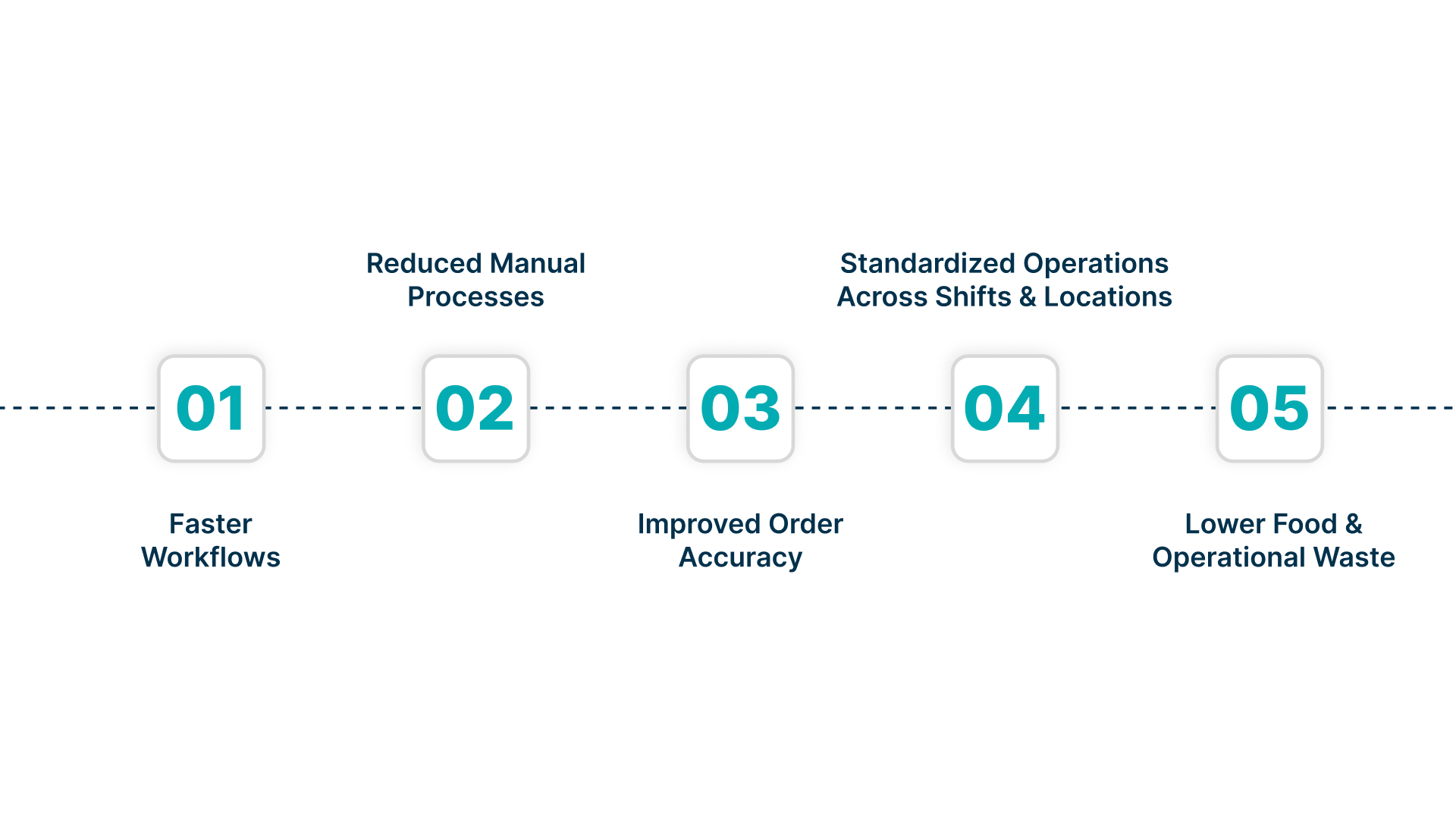
Key operational changes include:
1. Faster Workflows: Digital ordering systems, kitchen display screens, and automated task routing have significantly reduced delays between ordering and food preparation.
For example, orders placed through QR menus or online platforms are sent directly to kitchen stations without manual entry, eliminating bottlenecks caused by handwritten tickets or verbal communication.
2. Reduced Manual Processes: Tasks that once required constant staff input, such as updating inventory counts, routing orders, or reconciling sales, are now handled automatically through integrated systems.
This reduces administrative workload and allows managers to focus on service quality, staffing, and customer experience rather than paperwork.
3. Improved Order Accuracy: Direct integration between ordering platforms and kitchen systems minimizes human error. Modifiers, special instructions, and dietary notes appear clearly on digital displays, reducing missed items and incorrect orders.
Many restaurants have reported fewer remakes and improved consistency as a result of digital order flow.
4. Standardized Operations Across Shifts And Locations: Technology has enabled restaurants to standardize workflows regardless of who is on shift.
Menu builds, prep instructions, delivery routes, and service timing are consistent across locations, helping multi-unit operators maintain brand standards even with high staff turnover.
5. Lower Food And Operational Waste: Inventory tracking and sales analytics provide visibility into ingredient usage and demand patterns.
Restaurants can better align prep volumes with actual sales, reducing overproduction, spoilage, and unnecessary food waste, particularly during slow or unpredictable service periods.
Together, these operational improvements allow restaurants to operate with greater control and predictability. Technology has shifted daily service from reactive problem-solving to proactive workflow management.
Impact On Labor And Staffing Models
Labor availability remains one of the most persistent challenges facing restaurants. Over the past two years, staffing shortages, rising wages, and high turnover have forced operators to rethink how work is distributed across teams.
Technology has played a central role in reshaping restaurant labor models by shifting focus from headcount expansion to productivity optimization.
Key changes include:
Automation support for daily operations: Digital ordering, kitchen systems, and robotics now handle repetitive tasks that previously required dedicated staff.
Task reallocation rather than role elimination: Instead of replacing employees, technology enables teams to move away from low-value tasks and focus on guest-facing responsibilities.
Robotics-assisted service flow: Indoor delivery robots reduce walking-intensive work such as food running, allowing servers to manage more tables without increasing physical strain.
Scheduling optimization: Sales data and forecasting tools help managers align staffing levels with real demand, minimizing overstaffing during slow periods and burnout during rush hours.
Reduced employee fatigue: By limiting unnecessary movement and manual coordination, technology helps create more sustainable shifts and improves retention.
Together, these changes allow restaurants to operate effectively with leaner teams while maintaining service quality, which is a critical advantage in today’s labor-constrained environment.
How Technology Has Improved Customer Experience
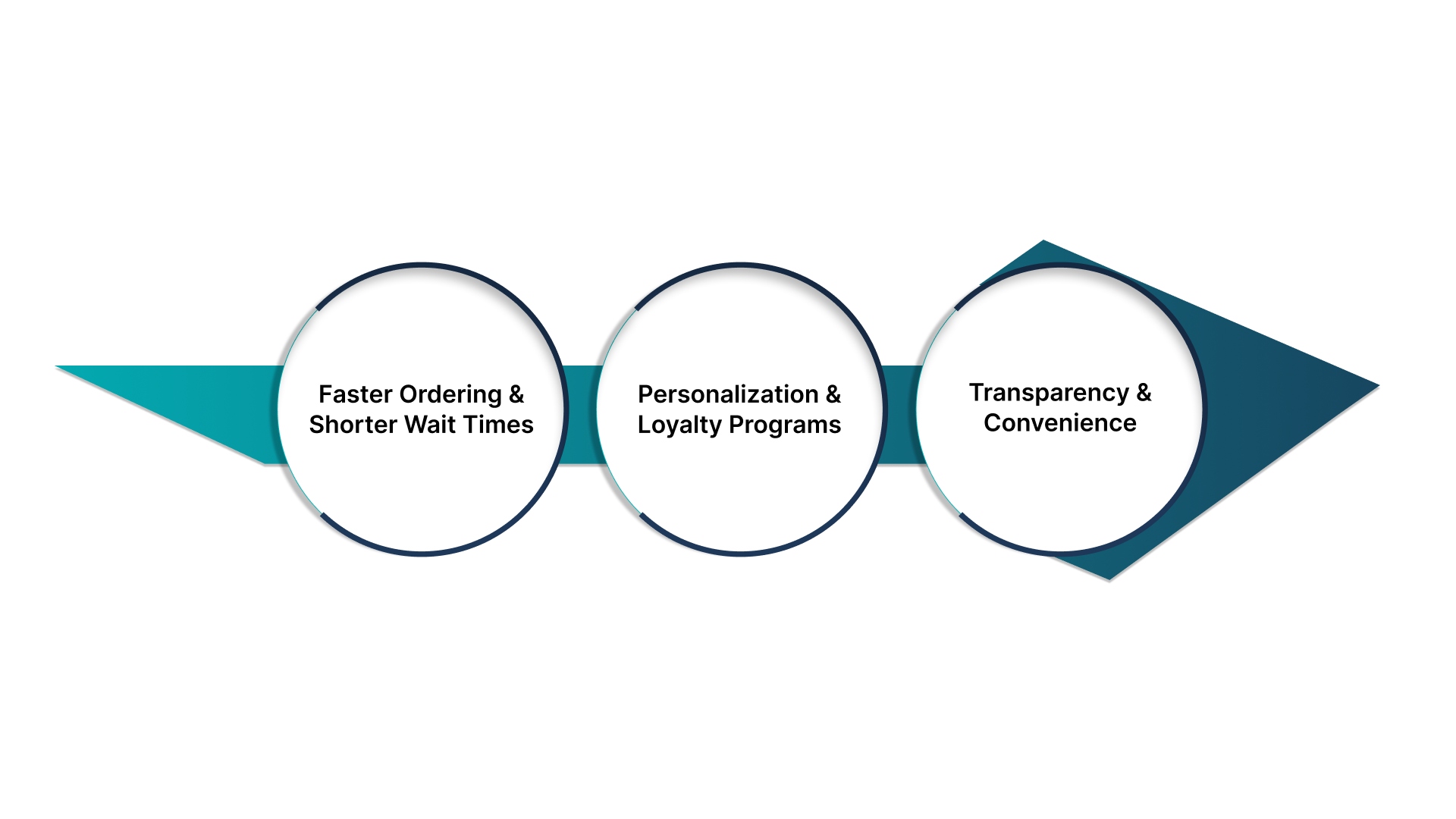
Restaurant technology has also transformed the guest journey, improving speed, personalization, and transparency from ordering to payment.
1. Faster Ordering And Shorter Wait Times: Digital menus, mobile ordering platforms, and pre-ordering options have streamlined the ordering process. Common improvements include:
QR-code menus that eliminate wait time for printed menus
Pre-ordering that reduces queue congestion
Direct order routing to kitchens for faster preparation
These tools help guests move more quickly from ordering to dining, particularly during peak periods.
2. Personalization And Loyalty Programs: Customer relationship management (CRM) platforms and AI-powered insights allow restaurants to deliver more personalized experiences. Restaurants can now:
Track customer preferences and visit history
Offer targeted promotions and rewards
Recommend menu items based on past behavior
This personalization strengthens loyalty while increasing repeat visits and average order value.
3. Transparency And Convenience: Modern diners expect visibility and control throughout their experience. Technology supports this through:
Real-time order tracking and status updates
Digital receipts and cashless payments
Feedback tools that allow instant service reviews
These features improve trust, reduce friction, and give customers greater confidence in the dining experience.
By combining operational efficiency with guest-facing innovation, technology has reshaped both how restaurants run and how customers experience them, creating faster, more predictable, and more engaging dining environments.
The Role Of Automation In Modern Restaurants
Automation and AI have become practical tools in modern restaurant operations, focused on improving predictability, efficiency, and consistency rather than replacing staff. Over the past two years, adoption has accelerated as operators look for ways to manage labor shortages and rising costs.
Today, automation supports both planning and execution across daily service.
Key applications include:
Demand forecasting: AI analyzes historical sales, seasonal trends, and day-part patterns to predict customer volume. This helps restaurants prepare accurate prep levels and anticipate peak periods with less guesswork.
Inventory prediction: Automated inventory systems track ingredient usage and forecast replenishment needs, reducing over-ordering, stockouts, and food waste.
AI-driven scheduling: Scheduling platforms use sales forecasts to recommend staffing levels by role and hour, improving labor efficiency while reducing manager workload.
Voice ordering systems: Voice-enabled ordering supports drive-thru and phone orders, improving speed and consistency during busy service windows.
Service robots: Indoor delivery robots assist with repetitive movement-based tasks such as food running and order transport, helping restaurants maintain service flow during understaffed shifts.
Cleaning automation: Autonomous cleaning robots support floor sanitation during off-peak hours, improving hygiene consistency while reducing reliance on overnight labor.
Together, automation and AI allow restaurants to move from reactive problem-solving to proactive operations, supporting staff, improving consistency, and enabling sustainable growth without increasing operational complexity.
Operational Benefits of Restaurant Technology
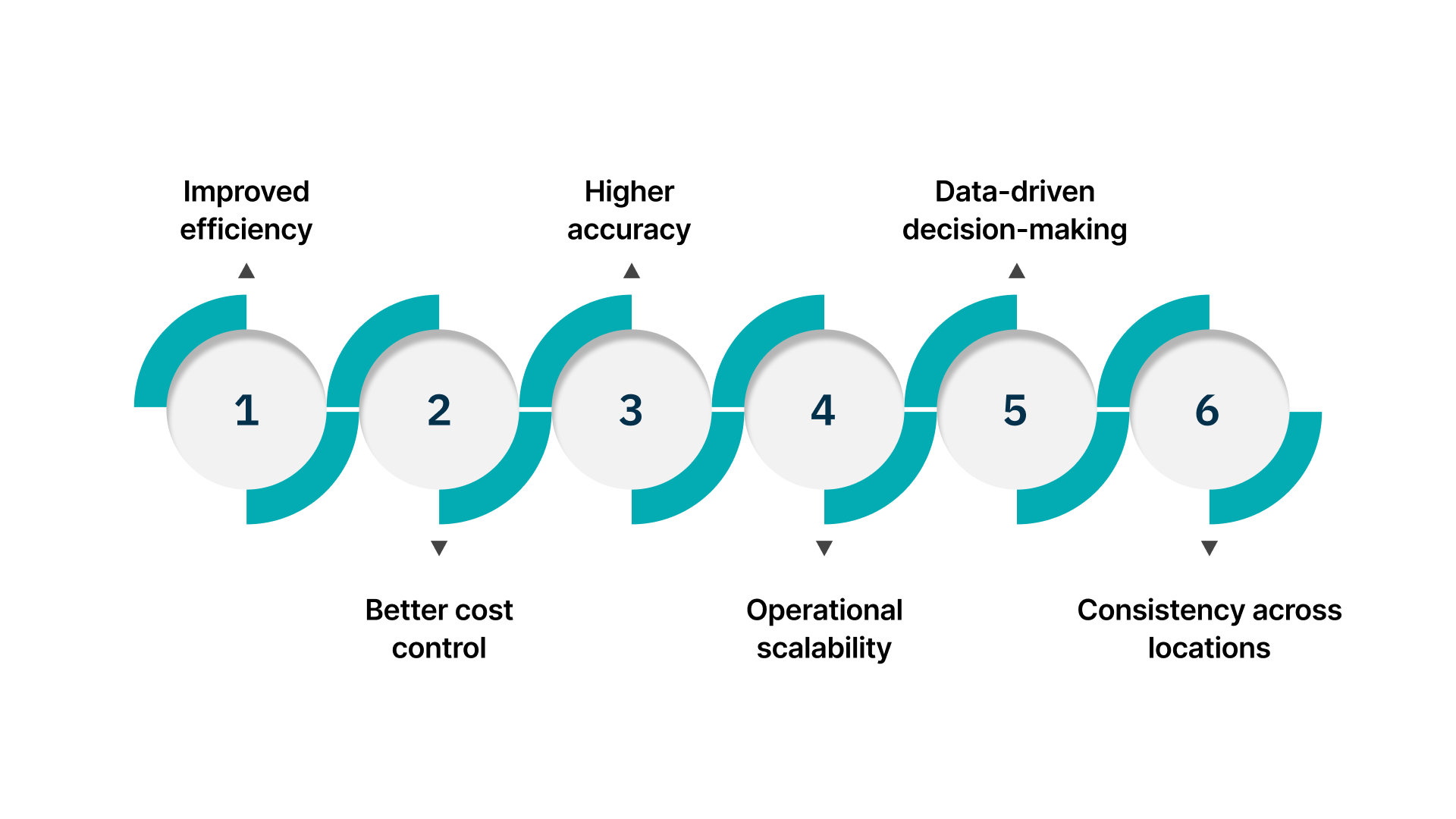
Restaurant technology delivers measurable improvements across both daily operations and long-term business performance. When systems are properly integrated, the benefits extend beyond convenience to create more predictable and scalable operations.
Key advantages include:
Improved efficiency: Automated ordering, kitchen workflows, and service support reduce delays and streamline day-to-day operations.
Better cost control: Real-time visibility into labor, inventory, and sales helps limit waste, overtime, and unnecessary expenses.
Higher accuracy: Digital order flow and kitchen display systems reduce manual errors and improve consistency across shifts.
Operational scalability: Standardized technology allows restaurants to expand locations or service models without increasing complexity.
Data-driven decision-making: Analytics provide insight into demand patterns, menu performance, and staffing needs.
Consistency across locations: Unified systems ensure menus, pricing, service timing, and workflows remain aligned across multi-unit operations.
Together, these benefits enable restaurants to operate with greater control, predictability, and resilience, even in high-volume or labor-constrained environments.
Real-World Restaurant & Hospitality Technology Use Cases
Restaurant technology adoption in 2026 is no longer theoretical. Many well-known operators across the United States are already using digital systems and automation to address specific operational challenges.
Below are real examples of how technology is being applied in day-to-day restaurant environments:
1. Chili’s: Robot Server Pilot
Chili’s tested a robot server in multiple U.S. restaurants as part of its service automation experimentation. The robot was used to carry food and drinks tableside, aiming to support front-of-house staff with consistent delivery during peak periods.
The deployment showed real interest in robot assistance at scale, even if not all pilot results moved to long-term use.
2. Denny’s: Delivery Robots for Table Service
Some Denny’s restaurants have deployed service robots to transport food and drink items from the kitchen to dining tables. These robots help free staff from routine delivery tasks and maintain consistent service flow during busy meal periods.
3. Marriott & Hilton Hotels: Dining & Restaurant Robots
Hotel restaurant areas within Marriott and Hilton properties have used robots to carry food and beverages directly to tables. These robots are designed for busy dining environments and support staff by reducing walking distances in large layouts.
These cases show practical, real deployments of robots supporting drink and food service in hospitality environments.
Challenges Restaurants Face With Technology Adoption
While restaurant technology offers significant operational benefits, adoption often comes with practical challenges that must be addressed early. These obstacles are typically not technical limitations, but issues related to cost, readiness, and workflow alignment.
Common challenges include:
Upfront investment: Hardware, software subscriptions, and implementation costs can require careful ROI evaluation, particularly for independent or smaller restaurant operators.
Staff training requirements: New systems introduce learning curves that may temporarily affect speed or confidence without structured onboarding.
Integration between platforms: Disconnected POS, ordering, and inventory systems can create data gaps and manual workarounds if not properly aligned.
Connectivity and infrastructure: Cloud-based tools depend on reliable internet access, making network stability and backup connections essential.
Change management: Shifting from familiar processes to digital workflows can face internal resistance without clear communication and leadership support.
When these challenges are acknowledged and planned for in advance, technology adoption becomes far more effective.
Restaurants that approach implementation gradually, with proper training, integration planning, and operational alignment, are better positioned to achieve long-term value without disrupting daily service.
Technology Trends Shaping Restaurants In 2026 And Beyond
As restaurant operations continue to evolve, technology adoption is shifting from short-term fixes to long-term strategy.
The next phase of transformation focuses on connected systems, predictive intelligence, and scalable automation that supports growth without increasing complexity.
Key trends shaping restaurants in 2026 and beyond include:
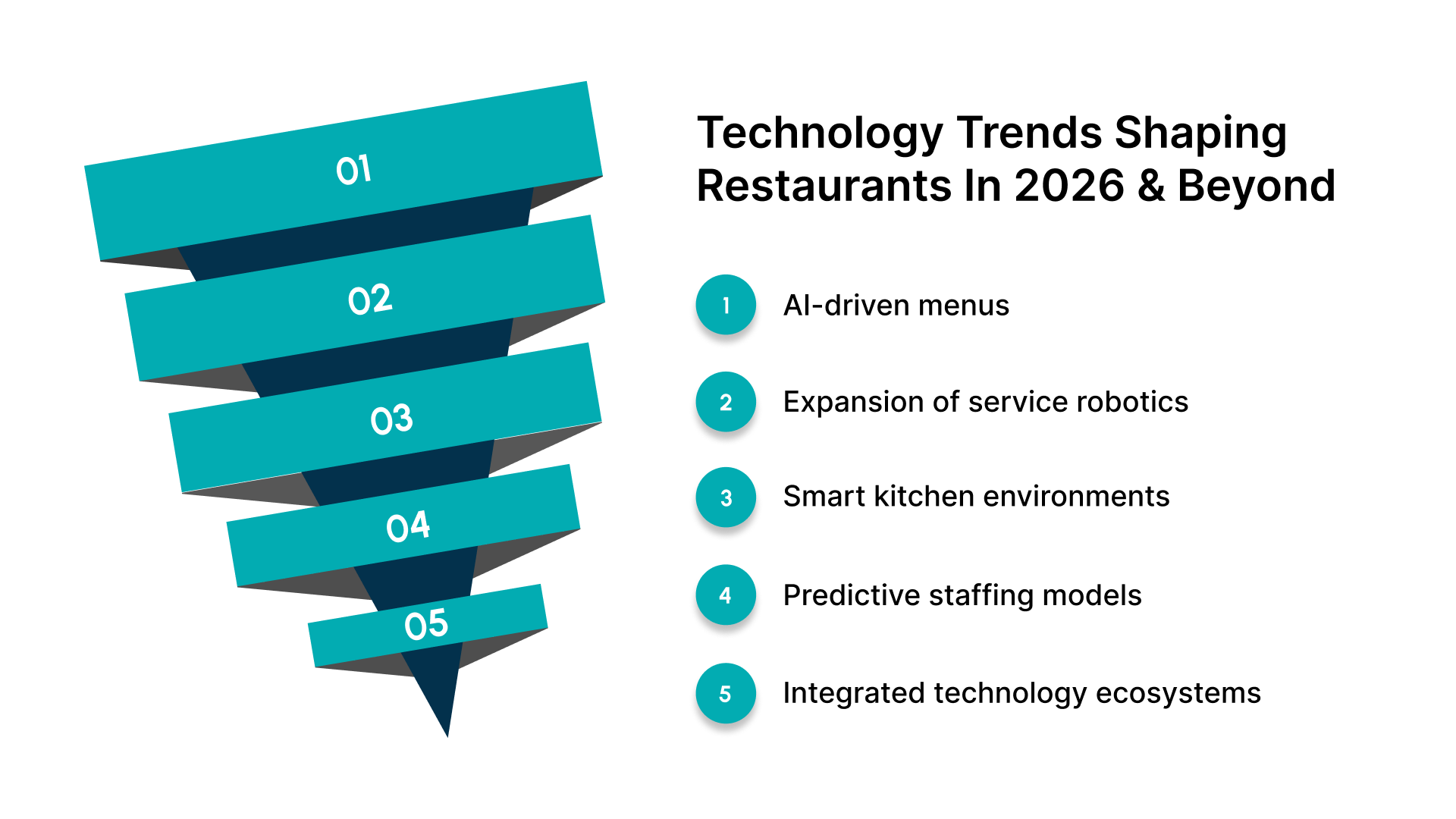
AI-driven menus: Menu performance data is increasingly used to adjust pricing, item placement, and availability based on demand, margins, and time of day.
Expansion of service robotics: Delivery and cleaning robots are becoming more common as labor shortages persist, supporting consistency across peak and off-peak hours.
Smart kitchen environments: Equipment, kitchen displays, and prep systems are increasingly connected, improving coordination, energy efficiency, and throughput.
Predictive staffing models: Scheduling tools now forecast staffing needs days or weeks in advance using historical demand and real-time trends.
Integrated technology ecosystems: Restaurants are moving away from isolated tools toward fully connected platforms that unify ordering, labor, inventory, and analytics.
Together, these trends point toward restaurants that operate with greater visibility, automation support, and adaptability, even as customer expectations and operating costs continue to rise.
What This Means For Restaurant Owners And Operators
For operators, the future of restaurant technology is not about adopting every new tool, but about making deliberate, outcome-driven decisions.
Successful adoption typically focuses on:
Strategic implementation: Selecting technologies that directly address operational bottlenecks rather than adding complexity.
ROI-driven technology choices: Prioritizing solutions that improve efficiency, labor utilization, or consistency with measurable returns.
Phased deployment: Introducing technology in stages to reduce disruption and allow teams to adapt gradually.
Competitive differentiation: Using technology to deliver faster service, more reliable operations, and better guest experiences than competitors.
Restaurants that approach technology as an operational strategy rather than a one-time upgrade are better positioned to remain profitable, resilient, and scalable in the years ahead.
Why Work With ToDo Robotics For Restaurant Automation
As restaurant technology continues to evolve, automation has become an increasingly important part of modern operations. ToDo Robotics supports restaurants exploring automation by delivering indoor robotic solutions designed to integrate seamlessly into existing service environments.
Rather than applying one-size-fits-all technology, ToDo Robotics takes an application-specific approach based on each restaurant’s layout, service flow, operating hours, and guest traffic patterns.
Depending on operational needs, ToDo Robotics provides:
Indoor delivery robots designed to support food running and internal transport in full-service, fast-casual, and high-volume restaurant environments.
Multi-tray and enclosed service robots optimized for table delivery, shared dining spaces, and long-distance service routes.
Autonomous navigation systems that operate safely in busy dining areas using LiDAR and vision-based mapping.
Fleet management software that enables real-time dispatch, monitoring, and coordination across multiple robots.
Automation solutions are selected based on how restaurants actually operate — not hardware specifications alone. ToDo Robotics works with operators to align robot deployment with walking distances, order volume, peak-hour pressure, and staffing models.
To support consistent daily performance, deployments can include:
Integration aligned with existing POS and service workflows
Configurable speed zones for guest-facing and back-of-house areas
Automated charging to support continuous-shift operation
This approach allows robotics to function as a natural extension of restaurant operations rather than a disconnected technology layer.
Beyond delivery automation, ToDo Robotics provides a broader portfolio of commercial robotics solutions that support efficiency and consistency across restaurant environments.
These include:
Autonomous cleaning robots for dining areas, kitchens, and service corridors to maintain sanitation standards during off-peak hours.
Robotics consultation and site assessments to evaluate feasibility, workflow impact, and ROI potential.
Installation and commissioning services, including mapping, testing, and configuration.
Staff training programs, delivered on-site or remotely to ensure safe and confident operation.
Ongoing maintenance and technical support, including preventive servicing and software updates.
By combining delivery robotics, cleaning automation, and full-lifecycle support, ToDo Robotics helps restaurants adopt automation strategically, improving throughput, reducing operational strain, and supporting consistent service as technology continues to reshape the industry.
Conclusion
Restaurant technology adoption presents different challenges depending on service model, staffing structure, facility layout, and daily operational demands. Implementing the wrong systems, or adopting technology without a clear operational strategy, can increase complexity, disrupt workflows, and limit long-term return on investment.
ToDo Robotics supports restaurant automation initiatives through application-specific service robotics, workflow-aligned deployment planning, and full-lifecycle support designed to integrate seamlessly within modern restaurant environments.
Speak with ToDo Robotics to discuss how automation can support your restaurant’s technology strategy.
Frequently Asked Questions (FAQs)
1. How Long Does It Typically Take For Restaurants To See ROI From Technology Investments?
ROI timelines vary by solution type and usage volume. Many digital tools deliver returns within months through labor savings, reduced waste, or faster service flow, while automation technologies often show value as usage stabilizes and workflows are optimized.
2. Can Restaurant Technology Improve Profit Margins Without Increasing Prices?
Yes. Technology can improve margins by reducing food waste, lowering overtime costs, improving table turnover, and increasing order accuracy — all without raising menu prices or impacting guest experience.
3. Is Restaurant Technology More Beneficial For Large Chains Or Independent Operators?
Both benefit, but in different ways. Independent restaurants often see gains in efficiency and visibility, while multi-location operators benefit most from standardization, centralized reporting, and consistent service execution across locations.
4. How Should Restaurants Prioritize Which Technologies To Adopt First?
The most effective approach is to start with technologies that address the biggest operational bottlenecks, such as order flow delays, staffing pressure, or inventory waste, before expanding into advanced automation or analytics tools.
5. Will Technology Continue To Change Restaurant Roles And Job Structures?
Yes. Technology is reshaping roles by reducing manual tasks and increasing focus on customer service, quality control, and oversight. While job functions evolve, technology is increasingly used to support staff rather than replace them.